Showing posts with label commercial brewing. Show all posts

Thursday, July 31, 2025

Does craft lager need to exist? Tasting notes: a macro versus micro taste test

Forgive the clickbait title, of course it does. Some of my favorite craft beers and breweries are lagers or lager-focused. What I am asking specifically is does craft American lager need to exist? Pedantically speaking, I am referring to styles 1A American Light Lager and 1B American Lager in the BCJP style-Guidelines. 

More and more craft brewers are making American-style lager. It used to be that craft beer was positioned as an alternative to bland, yellow beer. Other than responding to consumer tastes, what does craft American-style lager have to offer? Are craft brewers making better lagers than the largest lager brewers in the world? If so, is the quality difference significant enough to justify a higher price?

Let’s put it to the test.

Monday, January 6, 2025

12x12 Review: Jack’s Abby Winter Fest Variety Pack

12x12 is a new series dedicated to reviewing 12-packs of 12 ounce cans or bottles. Inspired by my guide to garage beer, 12-packs are often the workhorse of the beer fridge. The beer you bring to a cookout or grab on the way to a party. This series honors craft flagships, seasonal classics, and imported examples of classic styles.  


Beers included: House Lager, Post Shift Pils, Extra Layer, Dark As Hell

Purchased: 16 December 2024

Purchase Price: I forget 

Initial impression: Looking forward to circling back to two of Jack’s Abby’s core beers, two classic lager styles, and trying two new winter lagers  

Thursday, December 26, 2024

How to properly stock garage beer

A recent social media trend or meme depending on your point-of-view, especially among elder millennial dads is the garage beer. Garage beers are often accompanied by the musical stylings of Creed. The Kelce Brothers have even launched their own Garage Beer brand. A critical element of the garage beer is the garage fridge.


As a homebrewer with a four tap keezer, I still buy a fair amount of commercial beer. I don’t have a garage, but I do have a mini-fridge for beer in my basement. That was a Covid purchase. Initially our basement fridge was filled with Trillium when they were doing deliveries during the pandemic. In the time since, I have honed in on the ideal way to stock your beer fridge.

Monday, November 7, 2022

Cheap pale lager tier list

Food and beverages websites do love listacles. Every so often you see a prominent website put out a ranking of American lagers or cheap beers. The first one I remember was Deadspin's ranking of 36 Cheap American Beers. 

In a recent Vinepair article I shared on my Facebook page, my friend Randy from Twin Barns Brewing was among numerous professional brewers who were asked what their favorite macro light beer was. Craft beer drinkers probably don't realize how much pale lager professional brewers drink. When I was at the Craft Brewers Conference in Nashville the bars were running out of Pabst and High Life. 

There are a few reasons for this. Brewing is a physically demanding job. At the end of a shift something light and refreshing hits the spot. Brewers also like to be able to drink something without having to think too much about it. When you think about and critically taste the beer you make all day, it feels nice to shut off that part of your brain. A lot of brewers are also bored of IPA. 

Reading the Vinepair article got my wheels spinning a bit. I have my preferences when it comes to macro lagers, but like most things I struggle to name one favorite. 

One thing I don't struggle with is jumping on dead trends. One such dead trend is making tier lists. Instead of trying to pick one favorite and telling everyone why I think it is the best, putting macro lagers into tiers is a more manageable task.

What is interesting about macro lager is that there is more regional variation than some people realize. There are regional brands with a strong local following like Natural Bohemian in Baltimore. At the same time multi-national brewers like Anheuser-Busch will push some brands in some areas more than others. I was shocked to see Busch Light on tap recently in Iowa. Earlier this year when I was in Texas there weren't a lot of places that had Budweiser. 

Sunday, February 27, 2022

Revisiting seasonal beer

One of my favorite posts was my definitive guide to seasonal beer. Going by that schedule, I would be stocking up on spring seasonals if there was an actual spring training this year. It is hard to believe that I wrote that post eight years ago. At that time seasonal beers were a big deal and seasonal creep really annoyed me.  Seasonal beers were coming out so early that they were gone while being still "in season". I remember one year when I couldn't find Celebration in early December.

Many of the seasonal beers I used to look for were distributed by regional and national breweries. Yard Sale by Uinta was a sessionable dark lager released in the winter, a perfect antidote to full-bodied and boozy winter seasonals. Uinta is no longer distributed in Massachusetts. Even brewers like Sierra Nevada struggled to maintain traction with their seasonal lineup. I couldn't find Summerfest the last couple of summers. This year the beer will be retired and replaced with an IPA. As more local options emerged in the late 2010s, it became harder and harder for out-of-state brewers to keep shelf space at retail, and consciousness among consumers. 


In 2022 the notion of a brewery having a set lineup of four seasonal beers is as quaint. Sure, Sam Adams is still doing it, but that feels more like inertia than anything else. Breweries will release certain beers or styles seasonally, but you don't see as much of a set seasonal lineup. 

The main reason for the decline in seasonal beer is that instead of looking for a familiar seasonal with the change of ever season, drinkers want to try new beers and visit new breweries all of the time. The risk for brands is alienating people who love the old brands, and new beers not finding an audience. Samuel Adams has tried to keep a few of their venerable brands fresh by changing recipes for Summer Ale and Winter Lager.

As much as drinkers were trained to drink seasonally in the 1990s and 2000s, too many seasonal beers were similar. How many American Wheat ales with or without citrus do people want to drink? Fall was a deluge of cloying oktoberfests with too much caramel malt, and then it was pumpkin ales loaded with cinnamon. Winter was the domain of boozy stouts and overly-spiced winter warmers. Spring never quite had the same homogeneity, but people generally drink less from January to March anyway. 

This sameness over most of the beer year was probably always going to dampen enthusiasm for seasonal beer. Ironically, you could argue that the sameness of seasonal beer has been replaced by the sameness of New England IPA.  

Monday, February 22, 2021

Falling out of love with New England IPA

About six years ago I interviewed for a job with a decent sized craft brewery. The brewery was looking for a sales rep in my area. I was a sales professional in another industry and thought that might make me qualified for the position. The brewery was gracious enough to bring me in for an interview despite my only industry experience being a brand ambassador. I subsequently met the candidate the brewery hired. He was infinitely more qualified than me. 

During the interview I was asked a question along the lines of "What was the most impactful or influential beer you ever drank and why?" I completely choked on the question. Beer for me has always been a slow journey of incremental steps. Budweiser, to Sam Adams seasonals, to relatively hoppy beers like Harpoon IPA, it was an evolution. In hindsight one of my answers could have been Double Dry Hopped Fort Point Pale Ale from Trillium.  

Six years after I drank that beer for the first time, it was unlike anything I had drank before.  Sitting here in 2021, I remember my boss at the time buying that thick belgian bottle for me. I remember opening it at my cousin and occasional brewing partner Andy's home and sharing it with everyone on our brew day. That beer was so aromatic, and yes so juicy. A true revelation.

To be fair to myself, based on my first visit to Trillium in 2015 I may not have appreciated the experience fully. In that era any aggressively hopped IPA was called a West Coast IPA, so I erroneously lumped Trillium in with that crowd. 

One of my first hazies from 2015. Clear by 2021 standards. 

My early attempts at brewing IPA were not great. I needed a lot of help to brew a clone of The Substance. That recipe from 2015 is nothing like how the beer is now. Bissell Brothers have intentionally made the beer softer and hazier. I did learn a lot about brewing IPA generally from that experience. Within months of that visit to Trillium, I brewed my first hazy pale ale. A year later, as part of my US of IPA project in 2016 I brewed another New England IPA. In 2017, I wrote a post for HomebrewTalk sharing best practices for homebrewing New England IPA. 

The last NEIPA I brewed was 28 July 2018. Well, that's half true. I attempted to brew a Double NEIPA recipe I believe one of our commercial customers screwed up. I ended up screwing up the beer myself and dumping it. One of these days I have to give that recipe another try just to prove a point.

Anyway, over the last few years my brewing has shifted mostly to sessionable beers be it British styles, pale ales, lagers, or fruit and spice beers. As store shelves have become more and more full of New England IPA, we would buy commercial examples and I would brew styles that were becoming harder to find commercially.

The notion of regional variations in IPA isn't dead yet, but it might be dying. When I was in Michigan last year there were amber ales everywhere, but also plenty of hazies. Summer in Minnesota was similar, but with cream ales and kellerbier in place of ambers. During a whirlwind week in Texas where I visited Fort Worth, San Antonio, Austin, and Houston, it was pale lagers and hazy IPA. A legacy brewery in Denver wanted pricing to buy one of our distributors entire yearly allocation of El Dorado hops.  Even in San Diego, the mecca of West Coast IPA, in the afternoon I spent there in early 2020 there was as much if not more hazy IPA than West Coast IPA at the couple of places I visited. 

The more I drank New England IPA all over the country a few things became apparent. The more I drank NEIPA, the more not great examples I found. Just being juicy or aromatic wasn't enough anymore. As I drank more beers that were too aggressively dry-hopped, or were packaged too soon, I was getting "hop burn", and getting beers that were overly phenolic. I've gotten off flavors and aromas like cut grass, smoke, struck matches, and even lighter fluid. This is to say nothing of oxidized cans that poured brown with no hop character.

I have even had poor experiences from hyped breweries with huge Untappd ratings. One homebrewer shared on a "Currently Drinking" Slack channel I am on that he was drinking a newly released NEIPA from a prominent brewery. When asked how it was he said, "It's a bit spicy, as usual with day-of releases. But the tropical fruit is off the charts." He, like a lot of beer drinkers have been conditioned that when they buy a beer at a brewery itmay not be at it's peak of flavor or aroma. I've had similar experiences where I let the beer sit in my fridge for a week or two to smooth out. Twenty bucks for a four-pack doesn't buy what it used to.

With any beer style there are only two ways to really make a unique product: ingredients and process. With New England IPA the ingredients and processes are becoming increasingly similar. This has resulted something else I have noticed: a lot of hazy IPAs that taste the same. The grists tend to be very similar. There's a better chance that a brewery will talk about the unmalted adjuncts in the beer like flaked oats and flaked wheat than the actual malt. That is if they talk about the grains in the beer at all. Most breweries ferment with some kind of London III or Conan strain. If a brewery uses dry yeast it's probably Safale S04. The esters that used to make NEIPA unique compared to American ales fermented with neutral ale strains are now fairly similar across the board. Breweries having a house yeast with a house character isn't much of a thing anymore.

Hops are one area where there can be a difference if the brewer eschews the ubiquitous, but admittedly delicious Citra/Mosiac combo. Hop growers are selecting for varietals with tropical fruit flavors. As these new varieties are used in beers, they do make fruity and juicy IPAs. I am sure there are drinkers that can, or at least think they can pick out unique flavors from all of these hop varietals. There are plenty of times that I can't.

It would be easy to fall into the trap of blaming NEIPA for everything I don't like about beer in 2021. Breweries are business and brewers have stakeholders they are responsible to. Instead of complaining about NEIPA, I go out of my way to buy other styles I like when I see them. That's also a big reason why after three and a half years in the industry I have never fallen out of love with homebrewing. If I wan't variety, I can brew it myself. I am finally at a point where I have the knowledge and equipment to brew almost any kind of beer that I want.

Just because I don't drink New England IPA as much as I used to, doesn't mean I don't drink it at all. When I am in the mood, I still enjoy a well-made example. While I am working to get healthier, Jennie will offer me a sip of her beer which is usually hazy and hoppy. Sometimes the beer is great; other times she asks for help identifying an off flavor.

For the most part what is gone for me is the love. It's rare that I pour a hazy IPA, take a whiff of hop aroma, and feel close to the same excitement that I used to. 

Follow me on Twitter  @JChalifour
Like  The Would-be Brewmaster on Facebook

Tuesday, July 24, 2018

Don't be an anti-bottlite

Image result for bottles vs cans

I remember the first time I saw a can of Oskar Blues Dales Pale Ale. I was living with my cousin Adam at the time, and let's say friends showing up with beer was not an uncommon occurrence. When I saw this strange can in our vegetable drawer I wondered what kind of swill was inside. When I tried one I was blown away by the flavor.

Back then few people had seen craft beer in a can. Cans were the domain of macro beer. Now, in New England the overwhelming majority of craft beer is in cans. As brewers started marketing beer in cans they drilled the benefits of beer in cans into the heads of drinkers. Cans are lighter, cans block out all oxygen and light, you can take cans certain places more easily than bottles, and so on. 

Eventually the market has evolved to a point where consumers reject almost any beer in bottles out of hand. One local brewer told me bottle shops didn't want to carry his beer just because it was in bottles. When that brewer was able to switch to cans their sales went through the roof.

Things are getting to the point where the glass industry is starting to get nervous. Sponsored content like this from the glass industry has started to appear. A few months ago I saw a promoted tweet linking to an article about Yazoo Brewing in Nashville's new bottling line. One reply to the tweet accused Yazoo of "selling out" citing the advantages of cans that have become ingrained in the minds of many beer drinkers.

In the article Linus Hall of Yazoo explained, "... we feel that glass gives us the best chance to get that beer to our customers with low dissolved oxygen pickup." Low dissolved oxygen pickup is the key. While a can is air-tight, if there are high levels of oxygen dissolved in the liquid when it goes into the can that beer will metaphorically rot from the inside.

One of the barriers for craft brewers moving to cans was the availability and cost of canning equipment. Canning lines have gotten less expensive, and mobile canning companies enable craft brewers to rent a canning line without having to purchase one. There are even can seamers that allow small brewers to fill one can at a time. As more beer has been packaged in cans, the more bad beer I have had in cans.

Fill levels in cans can be a crap-shoot. I've spilled beer on myself and have had overfull cans foam over. Most damningly I have had several beers show obvious signs of oxidation. There is nothing worse than a New England Pale Ale that is brown like a rotten apple. Almost all hop character is gone and the beer is undrinkable. 

Image result for oxidized new england pale ale

Glass does have a few advantages to aluminium. Since a glass bottle is thicker and stronger than a can, it is easier to purge the vessel of oxygen. While aluminum is a finite resource that has to be mined, glass is made of sand. Earth has plenty of sand. If you are the type that is concerned about BPA, you can be sure there is no BPA in a glass bottle. One advantage for brewers is that bottling lines tend to be a lot faster than canning lines.

Like most things in life, cans and bottles both have their pros and cons. Don't be so beholden to cans that you refuse to buy beer in bottles. Any package is only as good as the liquid inside.

Wednesday, December 20, 2017

Pouring tallboys into glasses

When I was a younger man that frequented crowded bars, beer out of the bottle was ideal because my only concern was not spilling or splashing my beer if I was bumped into. I held my beer by the neck with my index and pinky finger like a douche.

As I slowly stopped going to those kind of places and really started exploring beer I realized the importance of pouring my beer into a glass. When pouring a beer into a glass it must be poured with some vigor. To truly enjoy a beer a good head of foam is essential. The size and retention of the head can vary by style, but it has to be there at least initially.


A proper pour does two things: the head traps in aromas from the beer, and it releases CO2 from solution. A slow pour intended to minimize foaming will lead to this:


The proliferation of the 16 ounce "tallboy" can has lead to, if not an epidemic of poorly served beers at least an outbreak. Beer drinkers, or God forbid beer servers can ruin a beer by trying to fit all 16 ounces in a tallboy into a pint glass. That can lead to pours like this:


No bueno. When pouring a tallboy into a glass, please pour it the same way you would a 12 ounce bottle. I start along the edge, and when the glass is 80% full I'll pour in the middle. At this point it is like driving a stick shift, I know when I need to change gears. If I am pouring one of my homebrews with low carbonation, I might pour the beer in the middle of the glass the entire time.

Getting back to tallboys, if your glass is full but there is still beer in the can, set the can aside. I keep two coasters on my end table just for this purpose. When my glass is around half empty and the head receded, I'll empty the can into my glass like this:


If this is how John Kimmich drinks out of a tallboy can, this is how you should drink out of a tallboy can.

Follow me on Twitter @JChalifour
Like The Would-be Brewmaster on Facebook

Thursday, May 11, 2017

Wicked Weed sells out to the High End

Two years ago Jennie and I went on an epic road trip full of beer and baseball. In addition to passing through Atlanta, North Carolina, and Delaware we spent a night in Asheville. Out of all the places we hit in the area, Wicked Weed was my favorite. I brought back a couple of bottles to save for a special occasion. About a year later Wicked Weed started distributing to Massachusetts.
Image result for wicked weed logo

Last Tuesday night we were sorting entries for our club's upcoming competition. As we sorted all of the entries we received we shared several bottles of Wicked Weed. Wednesday morning Wicked Weed announced that they had been acquired by The High End, AB InBev's craft division.

I have been more ambivalent than most in regards to these type of acquisitions. However I have found when it comes time to buy a beer I have a hard time pulling the trigger on purchasing beer from brands that have "sold out". Last September I was at Fenway Park I was all set to buy a Goose IPA until I saw cans of Harpoon IPA in a case.

Likewise I haven't purchased anything from Northern Brewer since their acquisition.  I've received numerous discount emails offering 10%, 15%, and even 20% off of my purchase, but I haven't been able to bring myself to spend my money there.

Working at Modern Homebrew Emporium every week mitigates the convenience of buying supplies online. When I do spend money on ingredients and supplies there is something to be said for spending it at a place that finds it in their heart to pay me! If there is something I couldn't get at the shop I think I would still prefer to support another vendor that isn't associated with AB InBev.

I can't blame anyone who creates something and then decides to sell it when offered an inordinate amount of money. I still unapologetically enjoy Leinenkugel's, and will probably buy Bourbon County on Black Friday. Still, I find that when I dig into my wallet more often than not I choose to support independent businesses, especially local ones.

There is some gray area as far as "selling out" goes. Brands like Redhook, Widmer, and Kona do not meet the Brewers Association's criteria for craft beer because their parent company, the somewhat ironically-named Craft Brew Alliance, is 31% owned by AB. Brooklyn Brewery sold 24% of their company to Japanese macro-brewer Kirin. The Brewers Association has to draw the line somewhere, but should that 7% difference make a huge difference to a consumer?

One of my favorite breweries Founders sold 30% ownership to Spanish macro Mahou San Miguel. As far as I know Mahou San Miguel doesn't partake in some of AB's more questionable business practices.

I have no particular animus toward any of these brands that have been acquired by AB or another macro-brewer. When I buy beer or buy brewing supplies I go with my gut. I don't buy a lot of sour beer. Maybe I'll pick up a bottle every couple of months. Next time I see Wicked Weed on the shelf I certainly won't feel the same way I felt that night we walked into the Funkatorium.

Follow me on Twitter @JChalifour
Like The Would-be Brewmaster on Facebook
Share what beers you are drinking with me on Untappd

Monday, April 3, 2017

Beer Inspiration in our Backyard: Barrel House Z

Barrel House Z (BHZ) opened in 2016 in Weymouth, Mass., and is a brewery that specializes in barrel-aged beers. Last year as they opened, BHZ sponsored their Launch Pad homebrew competition. I entered a second iteration of my Camp Randall Red IPA. I bottled my beer too soon, and the resulting batch was yeasty and overcarbonated. The over-carbonation caused the beer to gush.

Wanting to foster relationships with local homebrew clubs, when BHZ put together their Lift Off Competition for 2017 they restricted entry to homebrew club members that live within 25 miles of their Weymouth brewery. As I lived more than 25 miles away I couldn't enter the competition this year, but I did volunteer to judge. The competition was organized by the MASH Holes who I had a great time hanging out with at Jamboree and Homebrew Con.

Judging was at South Shore Homebrew Emporium in Weymouth. After sleeping through my alarm I managed not to arrive too late. In the first round I judged Strong Dark Lagers, and then participated in the Best-of-Show judging. Six beers advanced to the Best-of-Show round. Our job was to only pick the top three to be brewed on BHZ's pilot system. From there, the beers will be served at the brewery and winner selected at a special event.

For any readers not from Massachusetts, I live in an area north of Boston called the North Shore. Weymouth is located south of Boston on the South Shore. Although not separated by many road miles, Boston and it's poorly-conceived road and rail links separate the North and South Shore like Hadrian's Wall.

With no traffic on a Saturday morning it took me an hour to get to Weymouth. On a weekday it would easily have taken me twice as long. While I was in the area the plan was to always go to Trillium's brewery in Canton after judging. When I saw that BHZ was less than ten minutes from the judging site it made perfect sense to stop by the taproom as well.


The space at BHZ was really nice, lots of exposed wood and metal, and plenty of room to sit and relax. The staff couldn't have been more friendly.

I started with a taster of a juniper pils, Sunny & 79º. The juniper flavor was more prominent than most gins I have tasted, but it worked well with the base beer. I also enjoyed two barrel-aged stouts Adeline and Quaker State. I gave Adeline a slight edge over the oatmeal stout, Quaker State as I felt it had a more robust roasted malt and hop flavor. 

The two beers that got my wheels spinning a bit as a brewer were Townie a 9% Irish Red Ale aged in rum barrels, and Red Rye Ale #23, a 10% red rye ale aged in Jamaican rum barrels. Technically speaking the base beers would be in the American or British Strong Ale category due to their high ABV. In a commercial as opposed to composition setting I don't worry nearly as much about style parameters. A commercial brewer deserves wide latitude in how they describe their beer to the public.

These two beers were a revelation because the vast majority of barrel-aged beers are imperial stouts. There are some barleywines and a few Belgian dark strong ales. The only beer available locally that experiments with different styles and wood is Innis & Gunn. These beers showed the kind of flavor a scaled up Irish Red or American Amber Ale brewed with rye can produce. In both cases the rum barrel was perfect for aging. 

As homebrewers we should experiment with aging different styles with wood or in barrels. An ESB, Brown Ale, or even an IPA scaled up and aged on or in wood would make an interesting beer to try. Next time I go big with one of my beers, I think I might try a bit of an unconventional style. 

Follow me on Twitter @JChalifour
Like The Would-be Brewmaster on Facebook
Share what beers you are drinking with me on Untappd

Tuesday, November 22, 2016

Beer Inspiration in our Backyard – Cape Cod

The last couple of posts have touched on the fact that I am starting to seriously think about starting some kind of professional brewery. While I may have been slacking on brewing and writing, that doesn’t mean I haven’t been busy lately.

The biggest thing that has happened is that I started working Saturdays at the Modern Homebrew Emporium in Cambridge. My main job is to help customers and share my ‘expertise’ in brewing. Most of the customers on Saturday came in with their recipe knowing exactly what they were looking for, but I was able to help one customer buy their first starter kit and recipe kit. I look forward to making some extra money, meeting more people in the beer community, and having fun talking about  beer.

I had a prior commitment to pour for Newburyport Brewing Company on Cape Cod the first Saturday the shop wanted me to work. I worked for a couple hours at the shop in Cambridge, before driving to Centerville, MA. As I crawled down Mass. Ave I kept watching my estimated time of arrival become later and later.

The last time I visited the Cape was for a wedding. I was excited to have a chance to try beers on the Cape that don’t make their way up on the North Shore. While I was pouring at Cape Cod Package, I was able to sample beers from Cape Cod Beer and Naukabout Beer Co. I found both of their beer very easy to drink. Cape Cod is a vacation spot. When you’re on a boat or at the beach you don’t need a beer that hits you over the head. Next time I’m on the cape hopefully it will be a purely pleasure trip, and I can make time to stop by Cape Cod Beer and Naukabout Beer’s new tasting room in Mashapee that’s opening in the spring of 2017.

IMG_0841 IMG_0843

The nearest brewery was Devil’s Purse Brewing Co. in Dennis. I arrived about a half an hour before closing and grabbed a couple of sample pours. As I took a photo of the brewhouse from the tasting area, co-owner Mike Segerson invited me back and showed me around. We talked about beer, did a side-by-side with a couple of Newburyport and Devil’s Purse beers, and he shared some of his rarer beers including an oyster stout and a raw Nordic-style saison brewed with Juniper branches and fermented with every yeast at the brewery in a barrel. Knowing I had a long ride home, Mike even gave me a couple of cans of Mountain Dew for the ride home. My only regret was not grabbing a crowler of their IPA.

IMG_0845 IMG_0846

There was still one stop I wanted to make before heading home, the outermost brewery on Cape Cod: Hog Island Beer Co. in Orleans. In addition to my need to drive home responsibly, I was also absolutely starving having not eaten since breakfast. The brewery shares a building with the Jailhouse Tavern. It was pitch black when I arrived and I unwittingly walked into the tavern and sat at the bar. Seeing some Hog Island beer on tap and desperate to eat, I ordered the Hog Island Stout.

After my meal I asked the bartender where the brewery was. The brewery is actually in the back of the building, but is easily accessible via a path from the back of the restaurant. As I walked into the brewery there was live music, a pool table, and overall a more casual atmosphere. I enjoyed a sample flight and took a crowler of the Moon Snail Pale Ale to take home.

Brewing on Cape Cod is not easy. Many of the residents and business are seasonal in nature. There are no sewer lines on the cape which makes disposing of waste water more expensive than it is in other places. Luckily for vacationers and year-round residents there is plenty of quality beer brewed on the cape.

Follow me on Twitter  @JChalifour
Share what beers you are drinking with me on  Untappd


from WordPress http://ift.tt/2gh2doQ
via IFTTT

Wednesday, May 4, 2016

A beer drinker’s guide to Fenway Park

The Toucher & Rich show on 98.5 The Sports Hub ran their March Badness bracket, a bracket of the worst of Boston sports. This year’s winner was $10 beers at Fenway Park. I’ve been to three games at Fenway this year. The beers aren’t quite $10. At most stands it’s $9.25, or $9.75 for “craft”. Craft is in quotes because several of the beers that are marketed and sold for “craft” prices do not meet the Brewers Association’s definition of craft.

Nice night at the ballpark!

What I am not going to do is whine about beer prices. Yes, beer prices are obscene, but as a capitalist it is up to me to choose whether or not to voluntarily exchange my $9.75 for a beer. If the club decides that they would make more money by selling more beer for a lower price, they will lower prices. If they think that high beer prices are hurting attendance, they will lower the price of beer. I know my bank account didn’t take such a beating after going to three games in April, I would be more inclined to go to more games the rest of the season. That is a business decision for the Red Sox to make.

Two years ago the Washington Post conducted a thorough ranking of the best and worst beer selections at all 30 MLB ballparks. At that time the Red Sox ranked 22nd. In the past two years my hunch is that draught offerings have gotten worse.

Thursday, December 3, 2015

Goose Black Friday

I am not a patient person. The longest I will wait for anything is usually 20-30 minutes. I also loathe waking up early. Goose Black Friday combined both.

My idea of Black Friday.

My aversion to waiting usually extends to beer. I am not the type of person who will typically wait in line to buy a rare beer. Even when we drive up to Maine a few times a year I think the longest I have ever waited at Bissell Brothers is probably half an hour. Last week I made an exception.

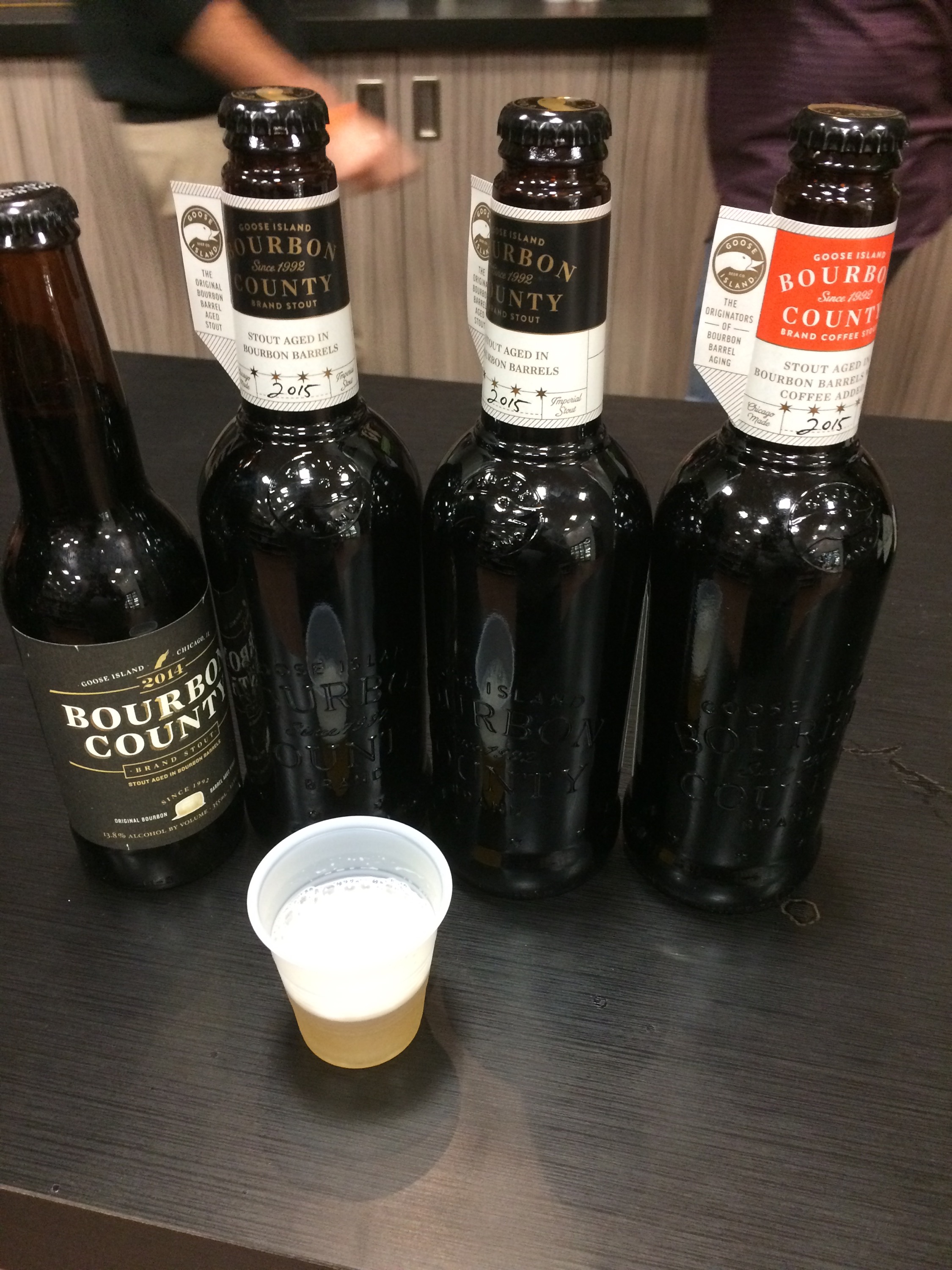
Every Black Friday Goose Island releases their Bourbon County line of beers. These beers are highly sought after and sell quickly. These beers are in excess of 12% alcohol by volume and aged in used Heaven Hill bourbon barrels for at least six months.

Friday, November 27, 2015

In Memoriam: Pretty Things Beer and Ale Project

Massachusetts brewing company, Pretty Things Beer and Ale Project announced they were ceasing operations on Tuesday. Some were shocked, but followers of the brand should not have been. The company was purposely called a "project" instead of "company" because projects are by definition not permanent. As a fan, it was a day I knew could happen at some point, but was saddened that it happened now.


Pretty Things was my favorite Massachusetts brewer. Every year I would always grab a bomber of Fluffy White Rabbits, Our Finest Regards, American Darling, and the rest of their beers as they were released. I also loved their Once Upon a Time series of historical brews they made in collaboration with brewing historian Robert Pattinson.

Tuesday, October 27, 2015

Tasting and festival fun!

Note: Newburyport Brewing asked if I would like to write some posts for their blog on the brewery website. This is a post about my experiences working events for the brewery. 

My name is Jason Chalifour. I am a homebrewer, blogger, Recognized Beer Judge Certification Program judge, craft beer fan, and have been working on the Event Team at Newburyport Brewing Company since May. As a side job there are worse things I could be doing than meeting people and talking about beer.

Wednesday, October 21, 2015

Big beer is getting bigger and I don't care

The two largest beer companies in the world, AB InBev and SABMiller have agreed to a takeover of SABMiller by ABInBev. Freelance writer Jason Notte wrote a reaction piece 5 ways the A-B InBev-SABMiller deal will ruin your beer. I thought it was an interesting, if alarmist take on the situation and tweeted the link.

Notte replied to my tweet and them mention tweeted:

Notte

I corrected Notte and told him that I never said what he accused me of saying. Will any "good" come of this proposed merger for craft beer? Probably not. Will it change my drinking habits? No. Do I think it will change the options available to me at local bars and bottle shops? No.

Wednesday, August 12, 2015

Hoarding your "sponge-worthy" beer

When Elaine from Seinfeld's contraceptive of choice, the sponge, was removed from the market she went out of her way to buy as many sponges as she could find. She then thoroughly vetted every potential sexual partner to determine if he was "sponge-worthy", less one of her precious sponges be wasted on a beau who was not sponge-worthy.


My uncle Dave loves Samuel Adams Cold Snap and stocked up on it while it was still on store shelves. He and a buddy of his made the sponge-worthy analogy when deciding when to enjoy one of their stash.  Although Cold Snap is Sam's spring beer and it is released in January, Cold Snap is actually a really good beer to enjoy during the summer. Witbier is light, refreshing, and has a bit of citrus flavor. That's what I tell people about Plum Island Belgian White when I pour for Newburyport. Dave finally enjoyed the last of his Cold Snaps at a sponge-worthy beach day a couple of weeks ago.

Friday, June 26, 2015

Working for a brewery

Shortly after visiting Newburyport Brewing Company last summer, one of my colleagues started working part-time for the brewery at events and tastings. A few weeks back he mentioned that the company might need another person to work these events. I casually told him to pass my name along. Before I knew it I was working at a tasting at Ralph's Wine and Spirits in Hingham just two days later! I work for the brewery on a casual, or on-call basis. If they need me to work, I receive an email and let them know if I am available to work or not.

Beer & swag laid out for a tasting.

That first tasting in Hingham was a lot of fun aside from the fact it took over two hours to get there from the brewery. I was stationed next to Foolproof Brewing. The owner of the liquor store had somebody bring down Heady Topper and Sip of Sunshine from Vermont. I had had Heady before, but this was my first time having Sip of Sunshine. The consensus seemed to have been that it was actually slightly better than Heady Topper. I don't disagree, but both beers are so excellent that you are splitting hairs to pick one. I would need to have a full can of both to really evaluate.

Monday, February 2, 2015

Budweiser misses the mark with "Brewed The Hard Way"

Lats week I wrote about 
what I would do to revitalize Budweiser. For the Super Bowl it does appear AB InBev is trying a different strategy to market the product.


There was plenty of Bud-hate on my Twitter feed last night after the previously unreleased "Brewed The Hard Way" ad aired during the Super Bowl. The reaction ranged from those that found it offensive, to those that found the inherent hypocrisy that a company who is gobbling up craft brewers like Goose Island and Elysian, looked like they were taking a shot at craft beer.  While not personally offended, I initially took it as a shot. Budweiser is insisting that no offense was intended. Budweiser's Twitter account was on the defensive after the ad aired.

Sunday, January 25, 2015

Reviving the King: A plan to bring Budweiser back

For lack of a better term many craft beer fans, myself included, have fallen into a trap. Our palates have been so wrecked by hoppy IPAs and super roased imperial stouts, that we deride the traditional and maligned American lager. The pretension that comes with looking down on mass-marketed American lagers is a craft beer right of passage.

Homebrewing has made me appreciate how exceedingly difficult it is to brew an American lager. If it is fermented at few degrees to high of a temperature, without pitching enough yeast, and sufficiently oxidizing the wort, the esters produced by the yeast will make the beer taste like a sour-apple Jolly Rancher.  That is if the beer fully attenuates at all, producing enough alcohol and sufficiently drying out the finish. The use of unmalted corn or rice can add additional steps to the mashing process. If the beer isn't cooled rapidly after the boil, it will never come close to the brilliant clarity it is supposed to have. If anything goes wrong at any point in the process there aren't copious amounts of hops and/or roasted malts to hide any imperfections.