Summer Somewhere has been the summer seasonal beer at my home brewery since 2015. I have described Summer Somewhere as being the same British Golden Ale recipe every year but with completely different ingredients. It really is a horrible way to describe applying the same recipe framework in terms of the same starting gravity, hop bitterness, and hop schedule, but changing the base malt, hops and yeast every year.
As this summer approached, I was thinking about how much seasonal beer has changed. Summer in particular was the domain of lighter styles like Blonde Ales and American Wheat Beer. Often these styles were lightly hopped and flavored with fruit or citrus like Samuel Adams Summer Ale, or were hopped a bit more aggressively with a moderate spicy or citrusy hop flavor like Riverwalk Screen Door.
The American Wheat Beer style used to be a lot more common than it is now, both in the summer and in general. Here is a rundown of the commercial examples cited by the Beer Judge Certification Program (BJCP):
Widmer Hefeweizen: One of the archetypes of the style. This beer used to be made at the old Redhook brewery in Portsmouth, NH. That facility is now the Cisco Brewery, and this beer is nowhere to be found in the northeast.
312 Urban Wheat Ale: Last time I had this beer was at a Goose Island bar at O'Hare Airport in 2017.
Boulevard Unfiltered Wheat Beer: This was the beer that made Boulevard. The beer's presence in the local market has faded like Boulevard has.
Bell's Oberon: It's huge following in Michigan guarantees this beer isn't going anywhere.
Harpoon UFO Hefeweizen: Not listed by the BJCP, but the first example I remember. Local bars used to serve it with a lemon wedge. I don't believe the beer has been discontinued, but I couldn't tell you the last time I saw it. Not being able to find it in awhile was one of the reasons I wanted to brew the style.
For 2022 I decided for Summer Somewhere to make my own American Wheat Beer. My recipe was pretty straightforward: 66.6% Maris Otter Extra Pale, 33.3% Wheat Malt, homegrown Centennial hops, and American Wheat yeast (likely sourced from Widmer).
When the beer was done and I tasted it for the first time, I really enjoyed it. The more I drank it, the more I started to believe something was missing. It was good, but felt like it might have been missing the mark in some way. Maybe the hop bitterness and flavor was too low. Using homegrown hops exclusively is a bit of a trial and error since you don't know what the alpha acid percentage is.
I decided to see how my beer compares to some commercial examples of the style. I visited my local Total Wine and found exactly two examples of the style. There were a lot more Belgian-style witbiers, or blonde ales with little or no wheat in the grist. When I shared this experience on my Facebook page, a couple commenters said it was because American Wheat Beer is not a style they enjoy.
For this beer I wanted something easy drinking, with a citrusy hop flavor without feeling like a New England IPA. I targeted 20 IBUs, and had equal hop additions at 60 minutes, 10 minutes, and 15 minutes in the whirlpool.
The two examples I was able to find were Oberon and Shipyard Summer Ale, a beer I had cloned previously. I poured all three beers in taster glasses and did a side-by-side. I jotted down some quick thoughts on all three beers, taking notes on aroma, appearance, flavor, mouthfeel, and overall impressions. Same criteria as a BJCP scoresheet, but not as detailed as if I was judging in a competition. Since my objective was to compare the beers and not determine the best beer, I didn't score the beers.
Discontinued beers can be a funny thing. Sometimes they are romanticized by many. Sometimes they are remembered by a few. One beer a lot of friends my age miss that is otherwise forgotten about is Samuel Adams White Ale.
Consider Sam makes numerous Belgian witbiers, I never understood why their original White Ale was discontinued and never brought back. Then after doing some research I found out that White Ale used TEN different spices and botanicals: orange and lemon peel, dried plum, grains of paradise, coriander, anise, hibiscus, rose hips, tamarind, and vanilla. That probably explains it then.
Around the time I was preparing for my Beer Judge Certification Program (BJCP) online entrance and tasting exams, I skimmed through the updated draft 2014 guidelines. The updated guidelines have not been implemented yet and are still under review. Competitions are still using the current 2008 Guidelines, and by the time the new guidelines are approved and implemented they will be christened the 2015 BJCP Guidelines.
Three hop additions, 60 minutes for bitterness, 10 minutes for flavor, and at flame-out for aroma.
The new guidelines have several new and additional styles that were are not included in the current guidelines. One that caught my eye was English Golden Ale. Brewers in England created the style in the 1980s to compete with mass-market pale lagers that threatened the existence of traditional British ales. Light in color, the beer is designed to appeal to a lager drinker, but it is hoppy like an American pale ale. Many brewers in the UK started to release Golden Ales seasonally in the summer. Locally Ipswich Summer Ale fits most of the criteria for the style.
British golden ale is a style I first learned about when the draft version of the new Beer Judge Certification Program style guidelines were published in 2014. The style developed in England as a summer seasonal. Light in color and body, British golden ale is perfect for the summer. Unlike traditional bitters which are primarily malt focused, golden ale has a similar hop character to an American pale ale.
This is my third batch of Summer Somewhere. Every year the ingredients have changed, but the recipe has been mostly the same: 95% base malt, 5% flaked maize, British yeast. In 2015 I used Irish Stout Malt, Irish Ale yeast, and Galaxy hops, while last year I used Munton's Propino malt, London Ale III yeast, and Styrian Bobek hops with Cluster for bittering.
While rushing to brew Summer of Jennie, Transistor Radio, 'Murica and another beer for Homebrew Talk, I decided to brew Summer Somewhere as an extract batch. The thinking was that I could more easily brew an extract batch on a double brew day. I ended up brewing the batch while bottling and racking several other batches.
In keeping with previous recipes I used Munton's Extra Light extract to give the beer a British malt flavor, but keeping the color as light as possible. I added half of the extract at the beginning of my boil, and the other half at the end to guard against the extract caramelizing in the kettle.
I did steep a little bit of leftover Propino malt from last year to try and impart some fresh malt flavor and aroma from the freshly cracked malt. There are conflicting reports about steeping as opposed to mashing base malts. I made sure to steep the malt in a temperature range where the starches had a chance to convert. In lieu of flaked maize I used simple corn sugar to lighten the body.
Munton's is the only extract I'll use in British styles.
Steeping just a little base malt.
With my malt and yeast I also took the easy route. I harvested some Ringwood Ale yeast from Transistor Radio, and used some of my bulk Centennial hops as the single hop
This batch is ready to bottle as soon as I dedicate some time to bottling. I want to enter it into a competition in July and have some time off coming up next week. I did rack the beer to a secondary to help it clear. This batch should be ready to go for July 4 and my homebrew club's summer cookout.
This is a belated Part II where I post some thoughts and reflections on beers I brewed in 2016. Click here for Part 1.
Salted Caramel Brown Ale – The other batch we brewed for Jamboree. Adding the actual salted caramel was an afterthought, which given the name of the beer was something of a problem. In a pinch I added Hershey’s caramel syrup and sea salt to taste when I kegged the beer. The beer didn’t have enough time to naturally carbonate in time for jambo. In the end the beer was a decent enough brown ale, with a slight hint of salt and caramel. I promised Jennie I would go back to the drawing board before brewing another salted caramel beer. I still have most of the keg in the basement. I think I will break it out for the North Shore Brewers holiday party in January. Rating 3 out of 5.
NSB SMaSH Base Malt – I jotted down some quick thoughts on the other SMaSH beers brewed by other club members. All of the beers were fairly boring, because the beer was designed to be boring. The point of the exercise was to taste the flavor contributions of various base malts.
The ingredient variable aside, having brewed basically the same recipe as several other brewers, my batch more than held its own. After my Galaxy IPA from the club’s single hop project finished overly dry last year, having this year’s club project beer be as solid as it was validates my brewing process as much as anything. I packaged the beer in four half-gallon flip-top growlers. I opened one at the club picnic. I brought two to jamboree to be served along with the club’s other SMaSH beers. I ended up dumping most of those when I needed to fill the growlers with leftover Broken Fist. Alas, I still have one growler left. Rating 3.75 out of 5.
Commonwealth v Chalifour – This was a tripel recipe I developed, that Andy and his brother AJ brewed. After rushing to have it ready for AJ’s 30th birthday party, we weren’t able to bottle the beer in time. Andy and I each kept four bottles, and gave the rest to AJ. I thought it was pretty good, if perhaps a little light for the style. Jennie said she got some sourness in the flavor. I didn’t really get it. I shared a bottle with the manager at the Modern Homebrew Emporium as part of my “liquid resume”. Plenty of esters from the Belgian yeast. Rating 3.5 out of 5.
Summer Somewhere 2016 – I had originally planned to bring this beer to Beans N Brews in June. However I let the beer sit in the secondary for too long before packaging, and it was not ready for the event. I ended up bringing bottles of Fort Dummer instead. I ended up bringing a keg of Summer Somewhere to AJ’s birthday party in lieu of the not-quite-ready Commonwealth v Chalifour.
The London Ale 1318 yeast definitely threw more fruit flavor into the beer than the Irish Ale 1084 I used in the 2015 version. The Styrian Bobek hops gave the beer more of a pilsner-type flavor. The beer tasted far more European than the citrus bomb that the 2015 version hopped with Galaxy was.
I brought a one gallon polypin to a North Shore Brewers meeting. The beer had fallen off considerably by then, but was still drinkable.
At AJ’s party there was a half-barrel keg of Samuel Adams Summer Ale and a quarter-barrel keg of Harpoon IPA. That my 3 gallon keg kicked that night is a point of pride. This is a beer I will brew every year. I might play around with different ingredients, but the bones of the recipe will never change. Rating 4.25 out of 5.
Fort Dummer – It’s never good when you find two ounces of hops in the freezer and realize they were supposed to go into the beer you just bottled. The batch was still pretty good. The folks at Beans N Brews enjoyed it even though they were expecting an English summer ale. When I drank it I kept thinking about the missing hops and in my mind the beer should have been better. When brewing four IPAs at once for my United States of IPA project, I made sure to pre-measure and label every dry hop addition to avoid making the same mistake again. Rating 3.5 out of 5.
In 2015 I planned out my brews. I made a brewing schedule like a commercial brewer. Sure there were some tweaks along the way, but I basically decided what I wanted to brew for when months in advance. I got away from it later in the year when I got into more small-batch brewing.
Beans N Brews is a similar event to the New England Homebrewer's Jamboree. It is an opportunity for the public to sample homebrew and to support the All Are Welcome community kitchen. As the name suggests the event has an informal homebrewing competition and chili cook-off. Assuming the weather ever warms up, a refreshing summer ale is a perfect beer to bring to an outdoor festival in June.
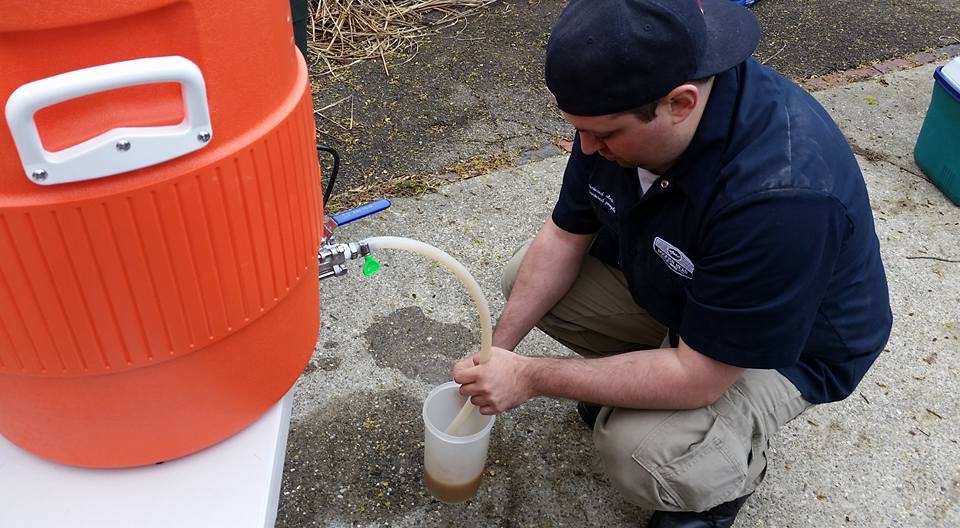
The North Shore Brewers had a beer camp on May 9 on National Homebrewing Day. This is where members of the club get together and actually brew together. Jennie is on board with any brew day that does not monopolize and mess up the kitchen. This also enabled me to brew a five gallon all-grain batch outside.
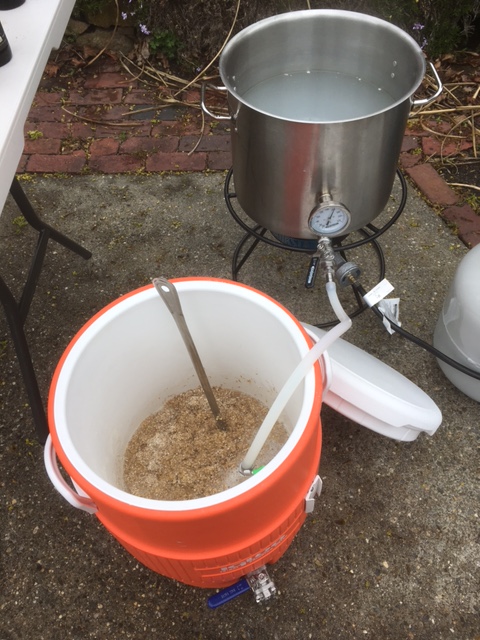
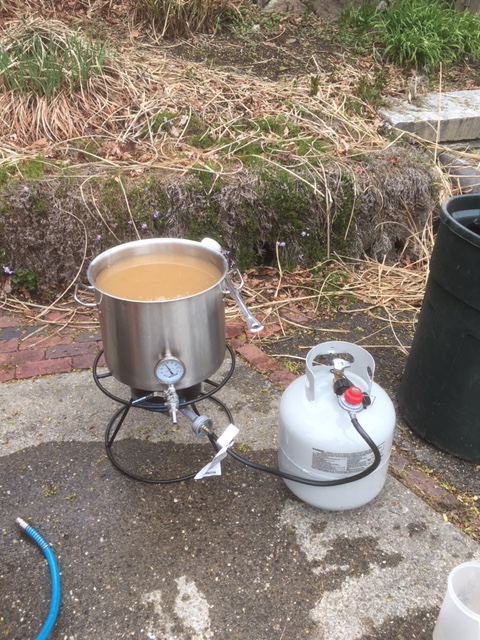
I already had a propane burner to brew outside that I received for free with a previous ingredient purchase. I picked up a propane tank at Dawson's in Beverly. I took advantage of a sale Beer and Wine Hobby in Woburn was having on National Homebrew Day to buy a brand new mash tun for 15% off. The mash tun is a round Igloo cooler with a false bottom. I have read this type of mash tun has better efficiency, meaning better extraction of fermentable sugars, than a cooler with just a screen like when I brew with Andy. I can bring this with me to his house for our next collaboration.
Loading and unloading the mash tun, burner, kettle, propane tank, ingredients, and beers I brought to share was a bit of a chore. It made me wish that when I bought a new car last year that I bought a hatchback or small SUV. Going to beer camps and other homebrew festivals makes me wish I had a bit more cargo space.
Last year I brewed Summer Somewhere with Galaxy hops. I always envisioned using a different hop every year. A British Golden Ale is a very interesting style. The malt bill is most similar to an International Pale Lager, it is hop forward like an American Pale Ale, all while traditionally using an English yeast. A few weeks back I was at the Modern Homebrew Emporium in Cambridge and noticed they had a bin of hops that were new to the shop. One variety that caught my eye was Bobek.
The description on the package said Bobek works in a variety of styles including ESB and lagers. That sounds ideal for a pale lager-like ale! Grown in Slovenia, they sound similar to Styrian Goldings, which is commonly used in Belgian Pale Ales and other Belgian styles. Styrian Goldings are actually English Fuggle hops grown in Slovenia.
After using 1318 London Ale III in the latest batch of Fort Dummer, it was easy to build up a starter for this batch. The malt is basically the same, except I switched up the base malt with the lightest English base malt I could find locally.
I expect the 2016 version to have a more floral and earthy hop flavor, than the assertive passion fruit flavor the 2015 version hopped with Galaxy. London Ale III is decidedly fruitier than Irish Ale, which will add some complexity.
With a five gallon batch I can keg three gallons for Beans 'N Brews, and bottle the rest for the summer.
The beer pours a very cloudy straw color. The beer looks like a wheat beer. That was not what I was going for. The head is a frothy, white and persistent.
The aroma features notes of passion-fruit and kiwi. There are dandelion eaters from the yeast. There is an underlying aroma of fresh cereal from the grain. Like when you first open the bag inside the box.
My last successful brew was August of last year. American Stout is a style I had wanted to tackle for awhile. Compared to Irish Stout, American Stout is higher in alcohol and often has an American hop presence. Once a staple of American craft brewing stalwarts like Sierra Nevada, the style is a bit harder to find these days. This was an example of designing a recipe and nailing it on the first try.
My next attempted brew was several months later. I designed a Christmas Ale recipe using Muntons Connoisseurs Nut Brown Ale extract beer kit as my base. The samples I pulled from the fermenter missed the mark. Then before I could keg the beer, a pelicile formed and the beer was infected.
Earlier this year I had a double brew day: an all grain Hazy IPA and extract Irish Stout. The IPA was super grassy and undrinkable. I blame this on using old hops and dry hopping for too long. I procrastinated kegging the Irish Stout, and that ended up getting infected like my Christmas Ale. Both batches were drain-pours. I also made a yeast starter for a saison I never brewed, and bought a pitch of yeast for the 2022 Summer Somewhere that is still in my fridge.
As summer began, my kegs were empty. My favorite time of year and I had no beer to drink. One reason why I brewed so little, and was so unmotivated to package what beers I did make was how cluttered my basement had become. Come May I had to make beer for the Muntons booth at Homebrew Con. That meant I had to do some long overdue spring cleaning and make some beer.
For the booth I made the following:
Two Muntons Flagship Hazy IPA kits. These hopped extract kits were easy to make on brew day, just dissolve the kits in water.
A ten gallon, partial-mash Hazy IPA made with Muntons new Oat Malt Extract. This was a fun brew. I brewed this with a 5-gallon partial boil, added the Oat Extract at the end of the boil to sterilize, and topped off with 5 gallons of water to get 10 gallons.
A 10 gallon all grain Hazy IPA. This was actually my first 10 gallon all grain batch I've brewed at home.
A 5 gallon partial mash Passion fruit Sour made with Muntons new Sour Malt Extract
In all it took me four days to brew all of this beer. The idea for the three different Hazy IPAs was to do a side-by-side at the booth. This beer needed to be in kegs three weeks before the show to have time to keg condition. After I was done brewing all of these beers for work, I gave my cooler mash tun, Brewers Edge Mash & Boil, 15 gallon kettle, and 8 gallon kettle a deep clean. Four days to make 40 gallons of beer for our booth. That wasn't all the beer I made for Homebrew Con either.
Earlier this year I submitted a seminar proposal to the American Homebrewers Association, which was accepted! If you follow my social media you may have seen that I will be giving a seminar on brewing English Ales. The rationale and motivation behind the seminar deserve it's own post, so I won't go into it here. As part of my seminar I could request beer service. Being able to taste recipes from the seminar, that apply my philosophy in brewing English Ales made too much sense not to do. Lets be honest, a seminar with beer is usually better than a seminar without beer.
Hearkening back to my days brewing in an apartment on an electric stove, I brewed four different 3 gallon brew-in-a-bag batches. I was able to brew these over two separate double brew days. Not sparging did impact my mash efficiency, but the time savings was worth it in this case. I will package these in my three gallon kegs and force carbonate them before driving from the Boston area to Pittsburgh.
That is 52 gallons of beer, in 12 corny kegs, that I made for and will be driving to Pittsburgh in my Hyundai Elantra. Hopefully I have room for my suitcase, CO2 tank, and jockey box. After all that, when I wanted a beer I had to go to the store. What a sorry state of affairs.
At least all this brewing gave me the impetus to clear out my brewing area and get back into a groove with brewing. If I want homebrew to drink for Independence Day and the rest of the summer, now is the time. Time unfortunately is not on my side. My VP wasn't thrilled I needed as much time to make all this beer for our homebrew team based in the UK. I can squeeze in one more brew day before the show. To make the most of that time I came up with a plan.
If there is one lesson that was reinforced brewing all of those beers for Muntons was how much of a time saver beer kits and extract brewing can be. I bought the Conneseurs Wheat Beer Kit and a can of Extra Light Malt Extract to re-brew a version of one of my favorite batches from a few years ago. I also have an extra can of the Muntons Sour Malt Extract I will combine with the Extra Light for another batch. Finally I will brew the 2022 vintage of my annual Summer Ale, Summer Somewhere.
By getting these in fermenters before the show, they will be ready to keg when I get back. No need to load up on Summer Shandy, Narragansett or Gennessee Cream Ale.
Crackerjack Cream Ale is the only beer I have brewed on an annual bases in my almost three years of homebrewing. I guess that alone makes this a special beer. Year-on-year I have only made subtle tweaks to the recipe.
Nice clarity, looks like I poured hard to rouse the head.
The beer pours straw colored. The fizzy head is thin and white. Head retention is low which is typical of the style. The beer has almost brilliant clarity. This is the best looking beer I have brewed in a long time.
Fear of missing out, popularly referred to as FOMO, is easy to succumb to as a brewer or even as a fan of craft beer.
As a brewer there are more beers that I would like to brew than I have to make, let alone time to drink. For this summer I wanted to brew a Bell’s Oberon clone, a Shipyard Summer Ale clone that I would split part of to make a Sea Dog Wild Blueberry clone, and I thought of making a Budwiser-inspired brew to mock some of the brand’s recent marketing foibles. Needless to say I didn’t brew any of these. I managed to brew two beers for the summer, my Westbrook Gose clone and Summer Somewhere.
Boston sports personality and provocateur Michael Felger once said, “Acceptance is the price of freedom”. It is important to accept that you as a brewer can’t brew everything you want. Many brewers have family and work obligations that make brewing difficult. Others have space and equipment limitations. Me, I have to accept that I can’t have a chest freezer converted into a kegerator (keezer) until we move to a bigger place.
As a beer drinker there are more breweries in the United States now than at any point in history. These craft brewers are coming out with new beers all of the time. We also have access to imports from all over the world. No matter how many new beers you want to try, you will never be able to try them all. It can even be difficult to try all of your favorite seasonal beers every year.
For some perspective, let’s say your circumstances dictate that you can barely brew enough to keep one beer on tap. Or perhaps you’re not able to drive out of your way to go to a brewery, and just drink what you can get at the local bottle shop. Chances are whatever you’re drinking is still vastly superior to what was available a generation ago.
Brewing and drinking beer are supposed to be fun. It is certainly more fun when you accept the fact that you probably won’t be able to brew an oktoberfest, pumpkin ale, brown ale, wet hop IPA, and hoppy amber ale for the fall on top of any house beers you try to keep year-round. It is impossible to go to every hot new brewery that opens, or try every great wait-in-line IPA.
My father has been in the painting business since before I was born. Most of that time he has been a painting contractor. For most of the last 10-15 years he has been contracting and sub-contracting exclusively, but when I was growing up he was still climbing ladders and swinging a brush. During the summer and on weekends I would go on estimates or go to job sites with him. Every once in awhile somebody would see this kid just hanging out, maybe reading a book or listening to the radio, and ask if I would follow my father's footsteps and take over the business. If my dad was around he would usually answer for me and say something along the lines of, "my son is smart, he will have a job where he uses his brain someday."
I'd call this a rolling boil.
While my intelligence, and certainly my common sense is up for debate, I did end up working behind a desk. Any desire I might have ever possibly have to pull a Peter Gibbons and forsake cubicle life for blue collar work went out the window after this brew day. The summer of 2015 has been kind of a dud. My girlfriend was calling June, "Junuary" due to unseasonably cold temperatures. Andy and I were fortunate enough to plan a brew day on the first day temperatures crossed 90 degrees. Not only was the heat oppressive, there was no wind, and for most of the day there was no shade in his yard.
I find yeast to be a particularly interesting topic in the world of brewing. Many brewers exclusively use a generic ale yeast like Chico be it Safale S05, Wyeast 1056, or White Labs 001, and do not give yeast a second thought. Many brewers just want the yeast to stay our of the way so the flavor from the malt and the hops can take the spotlight. Some brewers like Bell's and Harpoon have house strains that they use. Bone Up Brewing opened in Everett in 2016; they brew American styles, but with a Belgian yeast.
Up in Portland, some of the older craft brewers like Geary's are "Ringwood breweries" that exclusively use Ringwood Ale yeast. Geary's in particular has never bought a fresh pitch of Ringwood. They have repitched the same yeast from batch to batch for over thirty years. In that time their yeast may have evolved and mutated. I always got a cleaner taste with less diacetyl from Geary's beers as opposed to say Shipyard Export.
As a homebrewer, I enjoy experimenting with different yeast stains. Whenever I buy liquid yeast I try to harvest extra yeast from my starter. Last summer while I was busily brewing my US of IPA brews, and beers for Ales over ALS, I neglected to label a couple of my jars. The gars sat in the fridge for a period of months and Jennie was tired of looking at them.
Mystery yeast!
While I was trying to figure out what kind of beer I should brew with the second runnings of Wee Heavy I had an idea, why not just throw all of the yeast in a batch and see what happens? It felt crazy enough to work. These are all strains I've used before and loved. Why not use them together and try to make something unique? If it works I can keep using it like Geary's has used the same yeast for as long as it has.
One of the jars was labeled 1187, that would be Ringwood likely harvested from my yeast starter for Age of Sail. One jar I am fairly certain was 1318 from my 2016 Summer Somewhere. The other jar could be 1272. The other possibility is that it is The Yeast Bay's Vermont Ale. I froze some of the yeast back in 2014. When I tried to build it up last summer the fermentation wasn't that active so I bought fresh yeast for my NE IPA Haze for Daze. I may have saved that slurry also. I also dug around and found an older jar that was labeled 1318. If nothing else I have learned my lesson about organization.
Boiling my second runnings.
After conducting two boils for the Wee Heavy, I was anxious to get this over with. I ran the risk of tripping a circuit and boiled with two burners on the stove. I only added hops to the main kettle, while boiling the smaller pot just long enough to sterilize the wort. At the end of the main boil I blended the beer from the smaller pot back into the main kettle. The idea was to help cool the main wort while again sterilizing the wort from the smaller pot in the near-boiling kettle.
Given how old these jars were, I made a yeast starter and harvested a pint of my new blend. I decided to keep the recipe for my bonus beer fairly simple with one hop addition at 60 minuted and one at 10 minutes. After pitching my starter fermentation took off fairly quickly.
Beer is hazy, makes me think there's some VT Ale yeast in there.
With a double brew day looming, I pulled a sample to see if I could get an idea what kind of flavor my mystery blend would bring. The first samples tasted bitter and almost phenolic. I didn't trust it to pitch in another beer. I ended up buying new yeast for my double brew day.
A few days later on my double brew day, I racked the beer to a secondary to free up a primary fermenter. I was hoping some time in the carboy would mellow what I thought was an acrid beer. Before going through the effort of racking I gave the beer another taste to see if it was salvageable, and I was pleasantly surprised!
There were lots of esters in there. It is clear the blend is mostly English. The beer was quite hazy which makes me think there is Conan in the blend. The hop flavor was accentuated which is another hallmark of Conan. Even with two small hop additions, the hop flavor really shone through. At the same time, the beer didn't feel too dry which is something I have experienced in the past when brewing with Conan.
I think my blended yeast will be perfect for a New England IPA. I'll be sure to use it in the next one I brew.
After brewing imperial stouts in November of 2018 and 2019, my intention was to brew another vintage in November of 2020. For whatever reason I never got around to it. Then, at the end of January I brewed a batch of Rundown Irish Red as part of another project I'll be talking more about shortly. Low in alcohol and hops, the Irish Red was a perfect starter beer to build up plenty of yeast for an imperial stout.
That was the thought anyway. Fermentation on the Irish Red stalled, so I pitched a packet of US-05 dry yeast to help the beer finish fermenting out. The yeast I harvested from the Irish Red was some combination of Hugh Hill, my house Irish culture and US-05. For a one-off or vintage beer, I am not concerned about slight variations from batch-to-batch.
The night before brew day, I used a carbonation cap and a soda bottle to help dissolve the water additions. Chalk in particular isn't the most soluble, and carbonic acid helps it dissolve in water. This is something I have wanted to try for awhile, but I never seemed to have a soda bottle lying around. We typically don't have soda in the house. This was pretty easy to do and worked well.
This worked really well to get water salts to dissolve
What I did take away from this brew day was the desire to cut down on variations in process from batch-to-batch. Over the past couple of years I have experimented with batch sparging, fly sparging, no sparging, mashing in the Mash & Boil grain pipe, mashing in a cooler, boiling inside on the Mash & Boil, boiling outside on propane, checking pH on every batch, assuming pH calculations are good enough because I'm too lazy to calibrate a pH meter, acidifying sparge water, forgetting to acidify sparge water. On top of that I keep having issues with my mill jamming, adjusting the gap, and getting poor crushes through the mill.
The result has been that my yields have been all over the place. I brewed a barleywine that the yield was so poor I added two pounds of dry malt extract to compensate. Last summer my batch of Summer Somewhere came out close to 6% because my yield was really high. With this batch I think I have settled on a process that I can repeat.
I purchased two wire shelves for my Mash & Boil and cooler mash tun. The shelving also gives me storage space for my other kettles where they can drip dry after cleaning. From there I have a pump I can use when fly sparging. With this batch I focused on the flow of sparge water into the mash tun. I made sure there wasn't too much water on top of the grain bed, and that level was steady. The key was for the wort to drain at the same rate the sparge water was being sprinkled.
As full as my 8gal cooler can get
While milling, my mill was jamming and my crush was initially poor, I tightened the gap, and milled the grain again. The second pass made a huge difference. The endosperm of the grains were fully crushed, while the grain husks were still intact. If anything the crush may have been too fine, but the vourlauf and runoff on this batch was as easy as any batch I can remember.
Easiest vaurlauf ever
For the recipe I made a couple of changes from my last imperial stout. At the moment I was completely out of Maris Otter Pale Malt. Instead I used a malt we initially developed for distilling at Muntons called Northern Spring. In my experience Northern Spring is the highest yielding and best attenuating malt that we have. This was the malt I used in my 6% Summer Ale that was supposed to be 4.9%.After sparging, I ran off 10.5 gallons of wort. I wish I timed exactly how long I sparged for; it might have been an hour. When I took a refractometer reading, I was floored:
This is before I boiled off half of my wort
Pre-boil gravity was supposed to be 1.058, and I ended up at 1.068, I managed to overshoot my gravity by ten points! This beer is going to make my 2019 batch of imperial stout look like a dark mild. One option would have been to boil off less and make a bigger batch. If I had a large enough fermenter I may very well have done that. Instead I stuck with the 120 minute boil outside on my propane burner.
Half of the liquid was sacrificed in the name of high gravity brewing
One other change I made to make this vintage unique was to use my homegrown Willamette and Brewers Gold hops as the flavor and aroma hop additions. Those should give the beer a bit more of a unique touch.
After 120 minutes of boiling, here is my Starting Gravity:
Literally off the charts
Converting from Brix to gravity, the SG is 1.135. I aerated the wort as much as possible while transferring to a carboy. Then I aerated further with an aquarium pump until the carboy foamed over. From there I dumped the entire yeast cake from the Irish Red. I don't think it is possible to over-pitch an 1.135 wort.
I hit the wort with the aquarium pump again around 12 hours later. Fermentation was fairly active for about a week. The inside of the carboy was covered in caked-on krausen it was hard to tell what was going on. On day 13 after brew day, the gravity was down to 1.064. That's a high starting gravity for most of my batches. The beer had only had 50% attenuation, but was 9.8% ABV already.
The next day, I racked the beer to a secondary and pitched a vial of WLP099 Super High Gravity yeast that I used in Thomas Brady Ale (2017). Alcohol tolerant over 15%, this stuff will get the beer over the finish line. As I racked the beer, I could see there was still a fairly thick krausen on top. Maybe the original yeast needed a little more time, but at that point I was already committed to racking the beer.
As I siphoned, I didn't worry too much about racking yeast from the primary to the secondary. Any yeast in suspension should help the beer ferment out in theory. I checked the beer a few hours later, and there was already a krausen ring forming despite the temperature being a little below White Labs specification.
See you in three months buddy.
This is going to be the booziest beer I have ever brewed. At minimum this is going to be a 14% ABV beer. If the WLP099 attenuates here like it did in the Thomas Brady Ale, we are looking at a 17% beer. I'll believe I made a 17% all-malt beer when I see it, but either way this beer is going to be a sipper.
I never liked the name of my imperial stouts. The first batch, Employee Orientation was a tongue-in-cheek reference to the fact I brewed the beer as part of a colleague's training. 4PM Darkness was a reference to finishing the beer in the dark in November when it was dark at 4PM. That was the best I could come up with and always felt kind of meh. The name needed to be more epic.
As a baseball fan the last half of 2020, and first weeks of 2021 was very difficult as too many Hall of Fame inductees and legends of the sport have passed away in too short of a period of time. As these greats have left us, I would always see on social media a photo-shopped image of the recently deceased entering a cornfield, just as the deceased legends in the film Field of Dreams had done. This is a beer to honor them.
When Pretty Things Beer and Ale Project was still a going concern they were my favorite brewing company. A year and a half later I still have a few bombers in my beer fridge that I am holding on to. Their beer resonated with me be because like myself, Pretty Things brewed a wide array of styles. Pretty Things experimented without being different just for the sake of being different.
Last I heard, Pretty Things owners Dann and Martha Pauquette were brewing in Scotland. A year and a half later the taste of their flagship Jack D'Or becomes more of a distant memory. I opened my last bottle of the beer last November, almost a year after the brand ceased operations. I held onto that bottle for too long and just wasn't the same at all. Jack D'Or was a hop-forward beer and I should have enjoyed it fresh.
The last bottle...for now!!
Jack D'Or wasn't a pure saison like Du Pont. Dann and Martha conceived the beer as an American table beer. The malts and hops were all American. A firm bitterness and four yeast strains gave the beer its spicy flavor that made it drink like a Belgian saison. Like many local beer lovers, Jack D'Or was one of the first saisons I can recall drinking. The only way I could relive that taste and the proper level of freshness would be to brew a clone.
A website called Crafted Pours published a clone of Jack D'Or. I am not familiar with the website, and there is no individual listed as the creator of the recipe. The recipe looks reasonable enough. I used that as a bit of a starting point.
Pretty Things website is still up with some information on their core offerings. The information was just some short blurbs, no deails like ingredients, ABV, or IBUs that would be useful for my purposes. Thankfully Beer Advocate still has a more detailed description.
Based on the description I removed the rye from Crafted Pours recipe, while tweaking some of the other malts based on what we carry at the shop. I adjusted the hop regimen so that the Nugget and Palisade were added late in the boil to more closely match the description on Beer Advocate. BA indicated there were four hops total. I don't recall Jack D'Or having a huge citrus or pine flavor so American Pale Ale or IPA hops wouldn't seem to fit. I used Columbus for bittering, and Northern Brewer for flavor. Northern Brewer can give any style of beer a rustic flavor.
My BIAB grains in a bag
A saison is supposed to be a dry, effervescent beer. As such I did add some dextrose to the recipe to dry the beer out and enhance the phenols from the yeast. For yeast I used a sachet of Belle Saison yeast I picked up at Homebrew Con last year.
I was really tempted to brew a five gallon batch. Having not brewed in almost two months I wanted to keep my brew day simple, have time to pull off a double brew day, and bottle Summer Somewhere.
Pre-boil volume on point
Last year most of my batches were of the three gallon, brew-in-a-bag variety. This was my first such batch since February. I was still dialed in with this system. My volumes and starting gravity were both on the money.
A hair above three gallons
Like I did three years ago, I plan to combat the summer heat in the brewhouse by brewing Belgian styles that I can ferment at a warmer temperature. Brewing on the third floor in the summer can be quite hot. Running the stove and an air conditioner in another room makes my circuit breaker go crazy.
I took Homebrew Con week off in case we decided to or were able to go. The upshot was that I was able to plan my brew day on the coolest day of the week. I have two other Belgian-style beers planned that I will be brewing at home. Hopefully I can brew on a relatively cool day again.