After brewing imperial stouts in November of 2018 and 2019, my intention was to brew another vintage in November of 2020. For whatever reason I never got around to it. Then, at the end of January I brewed a batch of Rundown Irish Red as part of another project I'll be talking more about shortly. Low in alcohol and hops, the Irish Red was a perfect starter beer to build up plenty of yeast for an imperial stout.
That was the thought anyway. Fermentation on the Irish Red stalled, so I pitched a packet of US-05 dry yeast to help the beer finish fermenting out. The yeast I harvested from the Irish Red was some combination of Hugh Hill, my house Irish culture and US-05. For a one-off or vintage beer, I am not concerned about slight variations from batch-to-batch.
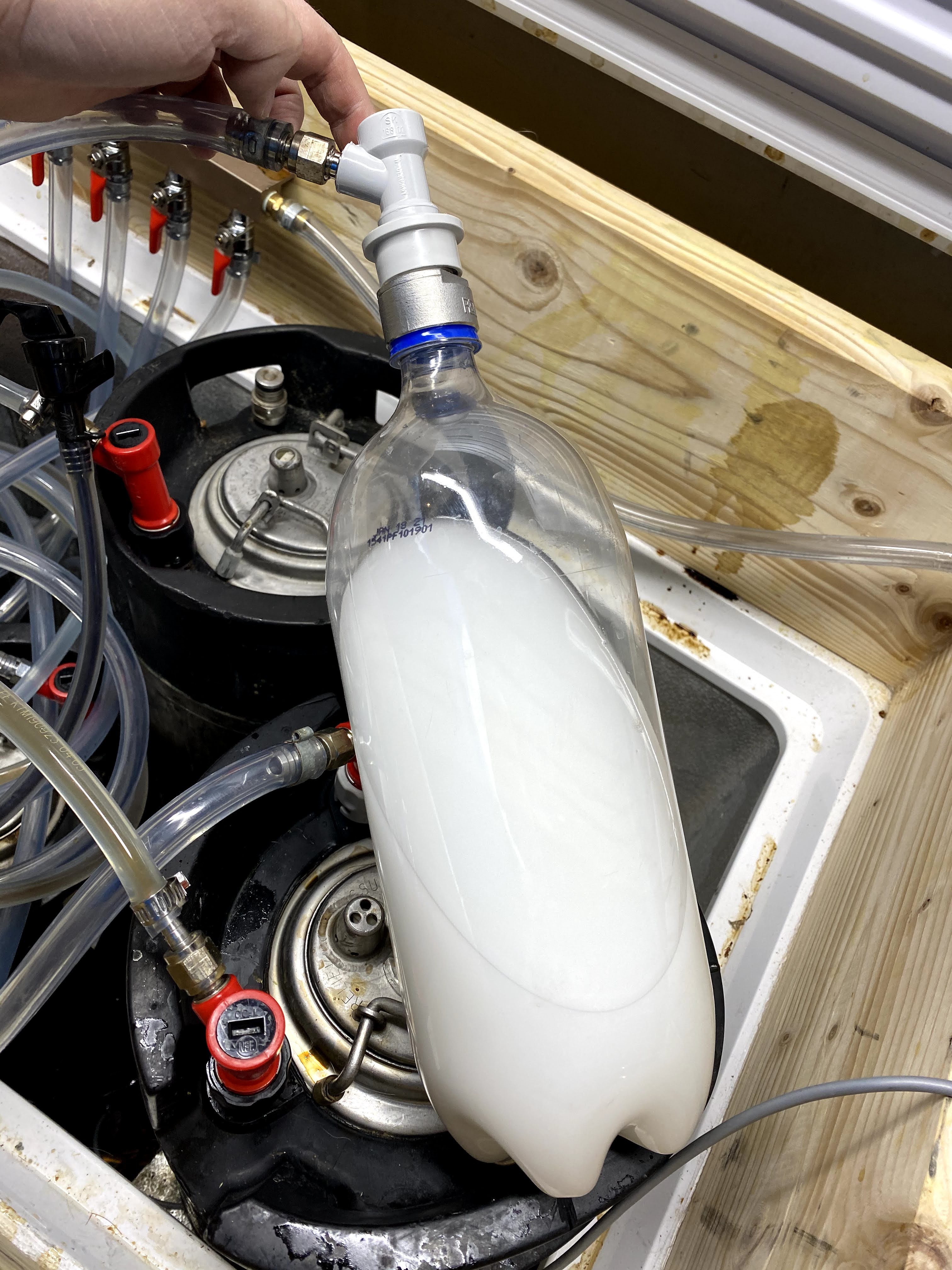
The night before brew day, I used a carbonation cap and a soda bottle to help dissolve the water additions. Chalk in particular isn't the most soluble, and carbonic acid helps it dissolve in water. This is something I have wanted to try for awhile, but I never seemed to have a soda bottle lying around. We typically don't have soda in the house. This was pretty easy to do and worked well.
This worked really well to get water salts to dissolve
What I did take away from this brew day was the desire to cut down on variations in process from batch-to-batch. Over the past couple of years I have experimented with batch sparging, fly sparging, no sparging, mashing in the Mash & Boil grain pipe, mashing in a cooler, boiling inside on the Mash & Boil, boiling outside on propane, checking pH on every batch, assuming pH calculations are good enough because I'm too lazy to calibrate a pH meter, acidifying sparge water, forgetting to acidify sparge water. On top of that I keep having issues with my mill jamming, adjusting the gap, and getting poor crushes through the mill.
The result has been that my yields have been all over the place. I brewed a barleywine that the yield was so poor I added two pounds of dry malt extract to compensate. Last summer my batch of Summer Somewhere came out close to 6% because my yield was really high. With this batch I think I have settled on a process that I can repeat.
I purchased two wire shelves for my Mash & Boil and cooler mash tun. The shelving also gives me storage space for my other kettles where they can drip dry after cleaning. From there I have a pump I can use when fly sparging. With this batch I focused on the flow of sparge water into the mash tun. I made sure there wasn't too much water on top of the grain bed, and that level was steady. The key was for the wort to drain at the same rate the sparge water was being sprinkled.
As full as my 8gal cooler can get
While milling, my mill was jamming and my crush was initially poor, I tightened the gap, and milled the grain again. The second pass made a huge difference. The endosperm of the grains were fully crushed, while the grain husks were still intact. If anything the crush may have been too fine, but the vourlauf and runoff on this batch was as easy as any batch I can remember.
Easiest vaurlauf ever
For the recipe I made a couple of changes from my last imperial stout. At the moment I was completely out of Maris Otter Pale Malt. Instead I used a malt we initially developed for distilling at Muntons called Northern Spring. In my experience Northern Spring is the highest yielding and best attenuating malt that we have. This was the malt I used in my 6% Summer Ale that was supposed to be 4.9%.After sparging, I ran off 10.5 gallons of wort. I wish I timed exactly how long I sparged for; it might have been an hour. When I took a refractometer reading, I was floored:
This is before I boiled off half of my wort
Pre-boil gravity was supposed to be 1.058, and I ended up at 1.068, I managed to overshoot my gravity by ten points! This beer is going to make my 2019 batch of imperial stout look like a dark mild. One option would have been to boil off less and make a bigger batch. If I had a large enough fermenter I may very well have done that. Instead I stuck with the 120 minute boil outside on my propane burner.
Half of the liquid was sacrificed in the name of high gravity brewing
One other change I made to make this vintage unique was to use my homegrown Willamette and Brewers Gold hops as the flavor and aroma hop additions. Those should give the beer a bit more of a unique touch.
After 120 minutes of boiling, here is my Starting Gravity:
Literally off the charts
Converting from Brix to gravity, the SG is 1.135. I aerated the wort as much as possible while transferring to a carboy. Then I aerated further with an aquarium pump until the carboy foamed over. From there I dumped the entire yeast cake from the Irish Red. I don't think it is possible to over-pitch an 1.135 wort.
I hit the wort with the aquarium pump again around 12 hours later. Fermentation was fairly active for about a week. The inside of the carboy was covered in caked-on krausen it was hard to tell what was going on. On day 13 after brew day, the gravity was down to 1.064. That's a high starting gravity for most of my batches. The beer had only had 50% attenuation, but was 9.8% ABV already.
The next day, I racked the beer to a secondary and pitched a vial of WLP099 Super High Gravity yeast that I used in Thomas Brady Ale (2017). Alcohol tolerant over 15%, this stuff will get the beer over the finish line. As I racked the beer, I could see there was still a fairly thick krausen on top. Maybe the original yeast needed a little more time, but at that point I was already committed to racking the beer.
As I siphoned, I didn't worry too much about racking yeast from the primary to the secondary. Any yeast in suspension should help the beer ferment out in theory. I checked the beer a few hours later, and there was already a krausen ring forming despite the temperature being a little below White Labs specification.
See you in three months buddy.
This is going to be the booziest beer I have ever brewed. At minimum this is going to be a 14% ABV beer. If the WLP099 attenuates here like it did in the Thomas Brady Ale, we are looking at a 17% beer. I'll believe I made a 17% all-malt beer when I see it, but either way this beer is going to be a sipper.
I never liked the name of my imperial stouts. The first batch, Employee Orientation was a tongue-in-cheek reference to the fact I brewed the beer as part of a colleague's training. 4PM Darkness was a reference to finishing the beer in the dark in November when it was dark at 4PM. That was the best I could come up with and always felt kind of meh. The name needed to be more epic.
As a baseball fan the last half of 2020, and first weeks of 2021 was very difficult as too many Hall of Fame inductees and legends of the sport have passed away in too short of a period of time. As these greats have left us, I would always see on social media a photo-shopped image of the recently deceased entering a cornfield, just as the deceased legends in the film Field of Dreams had done. This is a beer to honor them.
Below is an unpublished post from 2019 I wrote for another website. In addition to a regular Brew Day post, I took more of a "how to" approach like I did in some of my earlier posts.
I own four five-gallon glass carboys. When any of those carboys are empty it feels like a waste. Those carboys are taking up space in my basement when they could be aging some perfectly good beer!
With most of the standard strength ales I brew these days I don't bother racking to a secondary. Living in New England my basement is at a fairly steady 50 degrees during the winter. I can take advantage of the temperature to brew a lager and use one of my carboys for lagering. I can also use my carboys for aging sour beers or ciders. My favorite thing to use them for is to age high-alcohol beers. Long conditioning time in a secondary fermenter gives the complex flavors time to meld, and the alcohol time to mellow.
A year ago I brewed an imperial stout with my colleague Sven from Muntons. I took a recipe from a Gordon Strong book and adjusted the recipe to use ten different Muntons malts as a way to give Sven hand-on experience with as many of our malts as possible.
I was legitimately blown away with how great that beer came out. When I racked the beer after a week to a secondary it was delicious even then. I entered that beer into the National Homebrew Competition (NHC) where in the first round in Boston it won second in it's flight to advance to the final round.
While the beer didn't medal at the final round, and I didn't get my picture in Zymurgy, I did receive some solid feedback. I took that to heart while deciding how I wanted to tweak my recipe. At both rounds the judges thought the beer was maybe a little too roasty. At the first round in Boston the judges thought it was maybe a little too hoppy for a higher score. When the same batch was judged three months later, the hop flavor had subsided, but the judges still wanted more sweetness. With that in mind, here is the recipe I settled on:
Ingredients:
------------
Boil Size: 10.13 gal
Post Boil Volume: 5.63 gal
Batch Size (fermenter): 5.25 gal
Bottling Volume: 5.00 gal
Estimated OG: 1.110 SG
Estimated Color: 77.6 SRM
Estimated IBU: 78.4 IBUs
Brewhouse Efficiency: 70.00 %
Est Mash Efficiency: 72.0 %
Boil Time: 180 Minutes
14 lbs           Maris Otter Pale Malt (Muntons) (2.6 SRM)        Grain         60.9 %
3 lbs            Munich Malt (Muntons) (8.1 SRM)                  Grain         13.0 %
2 lbs            Wheat Malt (Muntons) (2.5 SRM)                   Grain         8.7 %
1 lbs            Chocolate Malt (Muntons) (520.3 SRM)             Grain         4.3 %
1 lbs            Crystal 150 (60L) (Muntons) (76.1 SRM)           Grain         4.3 %
1 lbs            Roasted Barley (Muntons) (634.5 SRM)             Grain         4.3 %
8.0 oz           Black Malt (Muntons) (634.5 SRM)                 Grain         2.2 %
8.0 oz           Crystal 400 (150L) (Muntons) (203.0 SRM)         Grain         2.2 %
1.00 oz          Nugget [13.50 %] - Boil 60.0 min                 Hop           43.9 IBUs
1.00 oz          Northern Brewer [8.10 %] - Boil 30.0 min         Hop           20.2 IBUs
0.25 tsp         Irish Moss (Boil 15.0 mins)                      Fining        -
1.00 oz          Fuggle [4.90 %] - Boil 15.0 min                  Hop           7.9 IBUs
1.00 oz          Phoenix [9.80 %] - Boil 5.0 min                  Hop           6.3 IBUs
1.0 pkg          Irish Ale Yeast                                  Yeast         -
Mash Schedule: Single Infusion, Full Body, No Mash Out
Total Grain Weight: 23 lbs
----------------------------
Name              Description                             Step Temperat Step Time
Mash In           Add 7.39 gal of water at 167.9 F        156.0 F       90 min

Sparge: Fly sparge with 5.60 gal water at 168.0 F
The only ingredients that a homebrewer might not be able to find are the Muntons Wheat and Munich malts. If you can't find those, I strongly suggest a quality imported substitute like Ireks White Wheat and Munich Malt.
Brewing high gravity beers like this does require some extra steps. Before I was with Muntons, I worked part time at a homebrew shop. When inexperienced brewers would come into the shop wanting to brew high gravity beers I would try to talk them through what to do. If I felt like the customer wasn't getting what I was trying to explain, or maybe didn't have the equipment needed, I would strongly suggest to the customer that they stick with a lower gravity brew.
Here are some of the challenges with high ABV brewing, suggested best practices, and what I did with this brew.
Yeast Pitching Rate - A high alcohol beer requires a high amount of fermentable sugar, which in turn requires a high amount of healthy yeast to ensure a thorough and clean fermentation.
With liquid yeast this usually means making a yeast starter and/or buying multiple pitches. I used to hate making yeast starters on a weeknight to be ready to brew on the weekend. Free samples of Proper Starter pre-made starter wort from Homebrew Con hooked me on the product immediately.
My favorite method for building up yeast cell counts for a high ABV beer is what I call a starter beer. Instead of making a 1.040 wort for the sole purpose of yeast propagation, I'll brew a batch of beer that is moderately hopped and has a similar gravity as a yeast starter. Bitters, Scottish Ales, English Porter, and Irish Stout are great styles for this method. For this batch I brewed an English Porter as a starter beer, which left me all of the yeast I needed for the imperial stout at the bottom of my fermenter.
If you don't have time to make a yeast starter or brew a starter beer, dry yeast is the easiest and cheapest way to go. Earlier this year I brewed an English Barleywine that got two packets of Nottingham. For any brew with an SG of over 1.080 I suggest pitching two sachets of dry yeast. No reason not to spend an extra $5-$8 to make sure your high ABV beer has enough yeast to ensure a full fermentation with no off flavors.
I pushed my system to it's limit.
Grist volume - When brewing a high ABV beer make sure your mash vessel can handle the volume of grain in your recipe and the strike water needed. I own a Brewers Edge Mash & Boil. The grain pipe in that system can only hold around 15 pounds of grain. Other brewing appliances of similar size like The Grainfather and RoboBrew have similar limitations. Instead of mashing in the Mash & Boil, I mashed in a ten gallon Igloo cooler. The grist and strike water filled the cooler to the very top. I could barley close the lid without pushing out hot mash water. Making sure you have enough room for your mash is just one reason to use a thick mash.
Good luck batch sparging this
Sparging - If your mash tun is as full as mine was, batch sparge or no sparge methods are out of the question. Fly sparging is your only option. That means you need a hot liquor tank with a ball valve that you can either gravity feed over your mash bed, or a pump to pump your hot liquor. If you don't have one, a sparge arm is a great investment to keep your grain bed level and avoid channels developing, which can lower your efficiency.
Efficiency - Whatever mash efficiency you normally achieve on your system, expect it to go down. A consequence of needing more water for your mash is that you need less sparge water to achieve your normal pre-boil gravity. One way to compensate for this is to sparge for longer, then boil off for longer to end up with the same batch size. Goose Island does a 180 minute boil when brewing their Bourbon County beers. With this batch I planned to try the same method. To handle my pre-boil volume of 10.5 gallons, I had to use my propane burner. That meant I was outside in Massachusetts in December. When my propane tank ran low on gas I lost my boil. When I switched tank I was able to get a rolling boil, but I did have to boil for longer. I am also hoping the longer boil gives me some kettle caramelization to give the beer additional sweetness.
Malt extract is your friend - Some all grain brewers look at malt extract the same way an avid mountain biker might look at a toddler's trike. Well, you shouldn't. More professional brewers use malt extract than people realize. Muntons sells dry malt extract in 55lb boxes to professional brewers, and we sell them by the pallet. Instead of employing a long boil like I did on this brew, take a pre-boil gravity reading and adjust your gravity with DME to hit your target. The imperial stout I brewed last year with Sven got 13oz of DME after the mash. If you are brewing on a brewing appliance with a limited grain capacity, just replace some of your base malt with malt extract. It's that easy.
Wort aeration - With a normal gravity beer splashing your wort in your fermenter will introduce enough oxygen into your wort. High ABV worts are a stressful environment for yeast. Your yeast will need more oxygen for a full and healthy fermentation. I ran an aeration pump for over half an hour while I was cleaning up from my brew day. That along with pitching plenty of yeast made sure my beer was fermenting within a few hours after pitching.
Temperature control - With all of the fermentable sugars in a high gravity beer, active fermentation is active indeed! That will generate quite a bit more heat than normal fermentation. Even if you pitch at the right temperature, the temperature can quickly rise too hot. With my beer I kept my fermenter in my 50F basement. and attached a heat wrap. I plugged the heat wrap into a temperature controller to keep my beer at a steady 68F
My plan for this years National Homebrew Competition (NHC) was to rebrew beers that had done well in previous competitions, or that I really enjoyed and thought would do well.
Employee Orientation 101
I have written a brew day post on this batch. I sent it to be published on another blog and have been waiting for that to go up before publishing here.
The grain bill pushed my mash tun to the limit.
I boiled ten gallons of wort down to less than five.
With this brew advancing to the final round in 2019, I was always going to rebrew it for 2020. I took the feedback I received from the judges and changed my recipe and process for this batch. The idea was for the malt flavor to be even richer. I increased the amount of Munich Malt to punch up the sweetness and breadiness in the flavor and the aroma.
During my brew day to improve my efficiency and increase the Maillard reaction in the wort, I extended my boil. When on a tour of the barrel room at Goose Island the tour guide said that Bourbon County has a three hour boil. I thought it would be interesting to try the technique at home with my imperial stout.
The brew day went fairly well. With my extended boil I ended up with around 4.75 gallons of wort and had an SG of 1.116. I pitched a huge amount of yeast from Derby Wharf Porter and fermentation took off right away. This was going to be great!
Then a few days after the brew day I went on a work trip. I would come to learn the difference between a 1.116 wort like this batch, and a 1.096 wort from the original batch was more significant than I realized. While the 2019 batch was almost fully fermented out and tasted pretty good after only seven days, the 2020 batch had stalled out and was noticeably boozy.
The higher gravity wort had stressed my yeast and resulted in a poor fermentation. The yeast needed added yeast nutrient and oxygen to finish fermenting. I should have added the yeast nutrient and hit the wort with my aquarium pump a couple days post-pitch, and then probably again a couple of days later.
I racked the beer to a secondary hoping the alcohol would mellow and perhaps the wort would pick up some oxygen and frement a bit more. After more time aging, I still wasn't happy with the beer and decided not to enter it at all into NHC.
I do want to brew this again. When I do, I will make sure I am home to add the yeast nutrient and oxygen this wort needs.
Uncommon Harvest
This was a rebrew of a 2018 recipe I made with my first harvest of homegrown hops. That year I planted Willamette, Northern Brewer, Chinook, Cascade, and Centennial rhizomes. Northern Brewer was the one plant that produced more than a few cones that first year. Anchor Steam is known for using Northern Brewer hops, so California Common was a clear choice for style to use those hops in. The beer I made didn't have much in the way of hop flavor, but the malt flavor was outstanding. Even though the lack of hop character made it miss the mark for style, I still thoroughly enjoyed that beer.
When I rebrewed the batch I wanted to use a domestic base malt in this quintessentially American style. I used Mapleton Pale Malt from my friends at Maine Malt House as my base. The specialty malts were all Muntons. To be sure the hop flavor and aroma was to style I used Northern Brewer pellet hops I purchased instead of my homegrown hops. The samples I tasted were if anything too bitter, but the beer could mellow with time.
Before I kegged the beer, I wanted to use my new toy to cold crash the beer. At the same time, I needed a temp controller for another batch. I thought I could just put the beer in one of the fridges, and use the dial thermostat that is built into the fridge. I turned it all the way down that should have gotten my wort to near freezing. I mean this is a mini-refrigerator not a mini-freezer after all. When I went to keg the beer it looked like this:
Yup! Frozen solid
That's two batches that would not have made it to NHC. I froze my California Common a couple weeks before the entry deadline. That gave me just enough time to brew another beer. I brewed a different style that I thought I could turn over quickly. That batch was a new brew and I'll talk about that batch in a separate post.
Fredward Wit
Last year I casually mentioned Fredward Wit took an honorable mention in the New England Regional Homebrew Competition. Fredward Wit, named after our cat, was a beer Jennie and I developed together and brought to the North Shore Brewer's 25th anniversary party.
The grist and hops are loosely similar to my previous Walk-Off White. When I was scooping the base malt brewing the first batch, I noticed that instead of the Pilsner Malt I had intended to use, I was scooping Muntons Super Pale malt. I thought to myself that Super Pale should work just fine.
Super Pale is a very interesting malt that a lot of brewers aren't familiar with. Lighter in color than even our Pilsner Malt, Super Pale was developed specifically for hoppy beers. With it's light color, the malt flavor is as restrained as possible which allows other flavors in the beer to come through more such as hops in IPAs. Super Pale is also a great choice in yeast-driven beers like saison. In Fredward Wit it really allowed the citrus and spices to come through. Super Pale is going to be my base malt of choice in all of my fruit beers going forward.
Where I did depart from Walk-Off White was the spice blend. For the most part Fredward has a sweet disposition, except when he demands treats, windows to be opened or immediate attention and pets. As such I wanted a sweeter spice blend. I replaced the lemon and grains of paradise with chamomile and vanilla. Jennie and I decided to use bitter orange and decided to use a bit more to balance the vanilla.
The judges feedback from the first batch was they thought the beer was a touch too hoppy. In the re-brew I eliminated the small flavor hop edition from the first batch and kept everything else the same. I think I may have liked the last batch better, but this second batch might be more to style. I can't find any glaring flaws in the second batch. I think it would have done well at NHC. I may have to brew it again for NHC 2021.
Spring Training Stout
Last year I wanted to bring back both of my house Irish beers, Rundown Irish Red and Spring Training Stout. I only had time and space to brew an extract version of Rundown Irish Red. I couldn't have been happier with how that batch came out. It had the complexity and drinkability I have always wanted my Irish Red to have. If I had entered it in competition I also think it would have done well.
While I could have easily rebrewed Rundown for NHC, by 2020 it had been five years since I brewed Spring Training and I missed it! While I thoroughly enjoyed Derby Wharf Porter, after finishing the keg I found myself craving a dryer and roastier stout.
As I revisited a five year-old recipe, I researched Irish beers and thought about how I would approach brewing Spring Training. Many Irish Stouts are brewed with British Pale Malts like Maris Otter or Planet Pale. Those are both great malts, but they are designed for all-malt brewing or brewing with a small percentage of un-malted adjuncts. Irish stouts can use quite high percentages of un-malted flaked barley to give the beer a full body. I read how one Irish craft brewery that uses a step mash to activate the enzymes they need to achieve full conversion of the flakes in the mash. Several Irish malters make a "Stout Malt" which isn't quite as flavorful as a pale malt, but does have a higher diastatic power than a British pale malt to convert more un-malted flaked barley typically used in Irish stouts.
Revisiting my last batch of Spring Training, the batch was a partial-mash with a base 5lbs of Stout Malt, 2lbs Flaked Barley, and 3.3lbs of Maris Otter Extract. My current batch was all-grain with Planet Pale as my base malt. I didn't want to try a complicated step mash. Being moderately concerned about the Planet Pale converting a large amount Flaked Barley, I replaced 1lb of the Flaked Barley with Wheat Malt. The Wheat Malt will add body, while also bringing it's own enzymes to the party because it is malted.
This change worked perfectly. The finished beer is rich, but drinkable. It is roasty with coffee notes, but not harsh or overly dry like some American-made stouts. That tells me that my water chemistry was on point.
One other change I was forced into was with my yeast. I pitched two jars of my House Irish Blend that I harvested from a prior batch. I didn't make a yeast starter, and the slurry never really took off. I sprinkled a sachet of S-04 which did a perfectly fine job fermenting the beer. In my mind the beer would have been better with my House Irish Blend, even if the beer is enjoyable as it is.
Enjoying my Spring Training stout on St. Patrick's Day while watching the Dropkick Murphy's.
Similar to Rundown, I think this recipe for Spring Training is perfect. For this batch I benchmarked one of my favorite beers, Guinness Extra Stout. The color is jet black with an off-white head. It has a nice roasty aroma. I am absolutely brewing this for next year's NHC and making a yeast starter for my House Irish yeast.