Showing posts with label judging. Show all posts

Thursday, August 2, 2018

More catching up


Every writer has their own creative process. For me it was easier to sit down and write when I was sitting down at a cubicle 40 hours per week. I would bang out posts during lunches and breaks. Now most of my desk time is spent researching breweries, managing inventory, and working on forecasts. Although I haven't been posting, I have been brewing, drinking, traveling, and judging.

I judged four flights at the first round of National Homebrew Competition (NHC) judging in New York. I was fortunate to judge some really strong flights, and judge one flight with a master judge. Brooklyn is an area I need to spend more time in as that is the real center of craft beer in New York.

Entry of Convenience, enjoyable but missed the mark.


I managed to enter two beers into NHC. Entry of Convenience scored a 29 which I think was completely fair. The judges thought it lacked the richness of malt flavor to score more highly. I thought the beer tasted like a fudgcicle. My second entry was Thomas Brady's Ale (2017) which scored a 37. That a score that high didn't even advance the beer to mini-Best of Show indicates how strong that flight was. The judges thought the beer was aged on the wood for too long. All I have to do is bottle the next batch sooner, easy enough!

At the end of June I made my return to Homebrew Con in Portland. Oregon. Manning a booth was a bit of a different experience; I didn't make any of the seminars. It was still a lot of fun. Portland is a great beer city. I found the Pacific-Northwest IPAs to be bitter compared to other regions, and I was pleasantly surprised at the variety of styles I found at the bars and breweries we visited. Next year Homebrew Con will be in Providence! All of the local homebrewers I've spoken with have been very excited.

The highlight of Homebrew Con in Portland for me was meeting this man:


Charlie Papazian founded the American Homebrewers Association, Great American Beer Fest, and wrote one of the bibles of homebrewing The Complete Joy of Homebrewing. Charlie had announced his retirement effective January 2019 and was chosen to give the keynote at Homebrew Con. I had seen Charlie in passing at other events, but knowing this could very well be my last chance to meet the man. The Complete Joy of Homebrewing was the first brewing book I owned and was the only book I brought with me to the show to potentially have signed. Not only was I lucky enough to get my book signed, someone had the presence of mind to take the above photo.

Hazy, but not quite turbid.


I brewed my first New England IPA at the new house. It was a blend of Muntons Pale, Wheat, and Caramalt hopped with Exp Stonefruit hops. On a friends advice I steeped the whirlpool hops at 140F. The resulting beer was quite tasty. It maybe could have used a touch more hop bitterness and haze, but the three gallon batch went fairly quickly. I want one of my four taps to have a NEIPA on all the time.

You can make a great beer with little effort!
Easiest beer I've ever made! All the ingredients are here!
Playing around with some of Muntons homebrew kits, I took Muntons Mexican Cerveza kit and made it my own by substituting amber and dark dry malt extract to make an amber lager. The kit contained hopped extract. That meant there was no boil. All I had to do was boil enough water to dissolve the extract in the kit and the dry extract, then top off with cold water. The top off water was cold enough to bring the wort down to pitching temperature. No need to run a wort chiller. The whole thing took 15 minutes. The resulting beer was a fair approximation of Dos Equis Ambar.

I learned how important mash pH is with a decoction mash.

Trying my hand at another beer inspired by Pretty Things, Modern Mower was my first attempt at a decoction mash. A traditional European method of mashing, decoction mashing invovles removing a portion of the mash, boiling it, and adding it back into the main mash to increase the temperature. Brewers who use decoction mashes now do so because they feel it imparts a richer malt flavor.

In my experience the decoction certainly gave the beer a richer malt color. The fatal flaw of my beer was I let the pH of my mash get too high. This extracted tannin and chill haze. The finished beer was slightly stringent and hazy. It was drinkable, but it missed the mark. Next time I need to add an acid rest and add a decoction, use some acidulated malt, or just acidify my mash. The good news is that these are easy fixes. That doesn't change the fact I should have known better.

Less is more with some spices like chamomile.

Jennie wanted to name a beer after our cat Fredward. Being a white monochrome short hair cat a witbier was an obvious choice. I wanted the beer to be slightly sweet like our kitty is. I tweaked the spices from my house witbier recipe adding vanilla and chamomile. The chamomile dominated the one pint of the batch I was able to try. It reminded my why I stopped brewing with chamomile. I want to make another witbier, but I think Walk-Off White will be coming back.

The reason I only enjoyed one pint of Fredward Wit was because the keg, along with Modern Mower, Cerveza Ambar, and Entry of Convenience froze. I was moving kegs inside of my keezer and inadvertently left the temperature probe outside of the freezer. The temp controller picking up the ambient temperature kept the compressor going. I tried defrosting the kegs, but they just didn't taste the same. I dumped everything in there.

In a couple of weeks we are opening our home to guests for the first time. I brewed six different beers for the occasion. Dumping those kegs at least freed up space. Check this space for details on all six brews.

Follow me on Twitter @JChalifour
Like The Would-be Brewmaster on Facebook

Tuesday, February 7, 2017

I actually won something

In my recent post Making hard cider at home, I admitted that the only medal I had ever won in a competition was for a cider. I was hoping to change that last year as I vowed to enter more competitions. I didn't brew quite as much in 2016 as I had in 2015. A lot of what I brewed last year was for events like Jamboree and Ales over ALS. Entering more of my beers into competitions was one of my Brew Year's Resolutions.

I had gotten great feedback on my latest batch Pa's Lager. Before that I entered Pa's Lager and Curly's Pumpkin Milk Stout into a competition in Portland, ME: the Groundhogs Day Homebrew Competition 2017 run by the Portland Mashing Maineiacs. Additionally I volunteered to judge in the competition. I'll take a built-in excuse to visit Portland. I made time to stop by Foundation and D.L. Geary's before heading home.

The competition wasn't huge with only around 100 entries. The categories were grouped into six different "tables" from which awards were given. I judged American Ales, American Porters, and American Stouts with a brewer and judge named Doug who is from nearby Swampscott, Mass. He was also a Certified BJCP judge and additionally he is a Certified Cicerone. Our scores tended to diverge a bit, but we were able to reach easy consensuses for the winners of both flights we judged.

Of the two beers I entered I probably had higher hopes for the Pumpkin Milk Stout. I was really happy with how that beer came out, and I thought it was a more forgiving beer and would better mask any flaws or off-flavors. After Doug and I finished our flights, I was milling around and saw the table where all of the judged beers were lined up. As I looked for my entries and any hopes I had of the Pumpkin Milk Stout placing were dashed. I found the bottle of Pumpkin Milk Stout with dried foam on the outside. If my beer gushed, there was no chance it would win anything.

The steward from that table told me the beer didn't gush when opened, but it did slowly foam after opening. I took a swig from the already judged bottle. It didn't taste offensive, but it clearly had fallen off from even a month earlier.

What I didn't find was Pa's Lager. The Best-in-Show judging was being conducted in a separate room that I could see into through a large window. I saw the bottles in contention for BOS on a table and I was pretty sure I saw a bottle with a yellow cap with the top filled in with black ink. Was that Pa's Lager? It certainly looked like it.

I made sure not to let myself get too excited, but as soon as I got home I kept refreshing the competition's website waiting for the winners to be announced. Finally, late on Monday night I saw this:

Pa's Lager finished in first place at it's table! After four years of brewing I finally have brewed a beer that medaled in a competition. I woke Jennie up to tell her and she was so happy and supportive. I shared the news with my family on social media. That a beer brewed in honor of Pa Chalifour won an award meant a lot to them also. 

For me as a brewer I was happy to receive the acknowledgement. In the past I have entered beer into competitions that I had high hopes for, but the entries maybe were not at the peak of freshness like the Pumpkin Milk Stout or I had entered "bad bottles" that were infected while the rest of the batch was fine. Some of the beers I have brewed that I thought were the best were made in too small of a quantity, or were consumed at an event like Jamboree, and couldn't be entered. This time everything came together. 

This past Saturday I received my scoresheets via email. Pa's Lager was judged by two professional brewers who gave it an score of 43.5. That is by far the best score I have ever received in a competition. Curly's Pumpkin Milk Stout received a 26. The beer did gush. The judges thought the beer was thin and too spicy. That is further evidence that the bottle was infected because having designed and tasted the beer myself, the beer was neither when it was young. 

Now, was this the biggest competition? In terms of number of entries it wasn't. I am entering three different beers in the Ocean State Homebrew Competition which should have five or six times the number of entries. I also applied for three entries into the National Homebrew Competition, the largest competition in the country. 

I have several projects I am working on at the moment. A couple of them are beer-related so check this space for details. The key is balancing work, brewing, and life in general. I need to keep my pipeline of fresh beer churning if I want to keep doing well in competitions. If I want to go to the next level, a closet full of medals will only help the cause and give me credibility.

Follow me on Twitter @JChalifour
Like The Would-be Brewmaster on Facebook
Share what beers you are drinking with me on Untappd

Monday, June 20, 2016

Pilgrimage to Homebrew Con: Judging at the NHC Final Round

In my first entry of the series I talk about the trip and what Homebrew Con is about. Click here
In my second entry I discuss the first couple days of our trim. Click here
Wednesday was the final round of judging at the National Homebrew Competition. The AHA and BJCP were looking for judges and stewards. Not knowing if I would ever have another opportunity to judge in the final round I really wanted to do it. I also didn't want to ditch my girlfriend for an entire day during our vacation. I ended up volunteering for just the morning session so we could spend the afternoon together.
   IMG_0227
Given my low rank, I figured I would be paired with an experienced judge. I sat down at my table, and saw I would be judging with Mike Dixon. The name sounded familiar, but I couldn't place it right away. Once we started judging I realized he is the admin for the BJCP Facebook Group. When I asked if that was him, he confirmed that he is the Communication Director of the BJCP. During a later seminar, author Denny Conn gave Mike a shout out as the first friend he made in homebrewing.
IMG_0229
Mike is a great guy. He is laid back, with a great sense of humor, and will use some colorful language if you meet him in person. It was a great experience to work with a judge that experienced. We were assigned Strong Ales which consisted of American and English Strong Ales and Barleywines. It was reassuring to me as a judge that my scores and thoughts were generally close to Mike's, even if I was usually a couple of points higher.
We went through our flight fairly quickly. This was aided by the modified scoresheets we used that employed check boxes for the different characteristics of the beer, with space to add any comments or feedback a judge might have. Most competitions require the judge to write everything out. At one competition I judged seven Northern English Brown Ales in a row and one every one I wrote out by hand "caramel malt flavor, with a dry finish". That is what the beer is supposed to have, but writing it out on almost every score sheet is tedious.
IMG_0231
There were three flights (three pairs of judges) at our table judging the same category. The judges at each flight selected one to three beers to advance to a mini-best of show (BOS) round. The highest ranking judges will taste the beers that advanced to the mini-BOS and determine which beers place first, second, third, and if any other beers deserve an honorable mention. This is done whenever there are multiple flights to ensure consistency.
For example, let's say I gave Beer A a score of 38, and another judge judging another beer in another flight gave Beer B a score of 36. If the award places just went by score Beer A would have placed higher based on scores generated by two different judges. Who's to say that I wouldn't have given Beer B a 39 if I had judged it?  With a mini-BOS judges can taste the best beers side-by-side and discuss which ones are the best and why.
I wasn't selected to participate in the mini-BOS due to my relatively low rank. Initially I was going to observe Mike and the other highly-ranked judges do the mini-BOS, but after waiting for several minutes I decided to eat some lunch and start taking in the rest of what Homebrew Con had to offer.
Follow me on Twitter  @JChalifour
Share what beers you are drinking with me on  Untappd

Wednesday, April 20, 2016

Beer Inspiration in our Backyard: Rhode Island

Boston is the home of two seminal craft brewers: Samuel Adams and Harpoon, while the greater Boston area boasts a burgeoning scene of newer craft brewers and cider houses like Night Shift, Jack's Abby, Far From the Tree, and Trillium. Portland, Maine is home to pioneers like DL Geary and Shipyard, as well as highly touted newcomers like Bissell Brothers, Foundation, and Rising Tide. Vermont has the most breweries per capita of any state as The Alchemist, Lawson's Finest Liquids, and Hill Farmstead brew some of the country's most sought-after beers. Sandwiched between Maine and Vermont, New Hampshire has several fine breweries. Portsmouth is an underrated beer city. Connecticut has a thriving beer scene even if many of the best beers brewed in the state don't make it to our corner of Massachusetts.
Of the six New England states, Rhode Island has been something of a craft beer backwater. The largest brewer in the state is Narragansett. Narragansett is my American Lager of choice, and Del's Shandy is a summer go-to. Although they have plans to open a brewery in Pawtucket, 'Gansett hasn't been brewed in the state for over thirty years. Everything you see in stores is contract-brewed out of New York state.
The site of the new Narragansett brewery is at a new facility called the Isle Brewers Guild. When completed the guild will in addition to partnering with established brewers to add brewing capacity, it will also assist their partner brewers in other business functions. Hopefully the facility will help the beer scene in Rhode Island grow.
I visited Rhode Island to judge at the Ocean State Homebrew Competition which was held at the guild. An old mill building, interior demolition was set to begin almost immediately after the competition was over.  I judged Pale European Lagers in the morning, and stouts in the afternoon. I was pleasantly surprised to have judged several Czech lagers in the morning as the Czech styles were only added recently. Most of the stouts I judged in the afternoon were solid as well. Noting I tried was mind-blowing, but there was only one beer that was undrinkable.
All the proceeds from the competition went to the Rhode Island food bank. The organizers did a great job assembling an impressive array of raffle prizes. All entrants and judges were invited to the final round of judging. For each food item donated to the food bank, a person was given a raffle ticket. Judges were given raffle tickets for volunteering his/her time. 
 
Jennie rode to Pawtucket with me and dropped me off at the competition. While I was judging she had more of a chance to check out the scene than I did. She visited Brewtopia Brewery and Kitchen where Revival Brewing is located. She gave both the Conga and Conga Imperial IPA a rating of 4.25 on Untappd. She also visited Tilted Barn brewery in Exeter. A very small, family-run brewfarm, she enjoyed the two beers she sampled, but was disappointed that The Chosen One DIPA keg kicked while she was there.
By the time I was done judging I was quite hungry. We stopped by a bar in Pawtucket called Doherty's. On the outside it looked like an unassuming neighborhood bar, but inside they had over 80 beers on tap and one of the most impressive bottle lists you will find. I tried some of the Rhode Island beers that I wasn't familiar with. The pale ales and IPAs tended to be maltier and more English-inspired. The standout beer was an Oatmeal Milk Stout by Proclamation Ale Company.
Proclimation has been vocal about the main culprit in limiting the growth of craft beer in the state: the state's arcane laws. In Rhode Island a brewery can only give a person three 4 oz samples at the brewery. Additionally they can only pour one sample at a time; flight paddles are illegal.  Breweries can only sell 72 oz of beer to go at the brewery. That works out to one six-pack, or one growler fill. Small breweries also can't self-distribute. None of the newer breweries in Massachusetts would have been able to survive with those restraints without radically changing their business model.
The one brewery I was able to visit with Jennie after dinner was Long Live Beerworks in Providence. I was so full I could only drink two of my three samples. Their 'Lil Sippy Pale Ale reminded me a lot of Peeper or Mo from Maine Beer Company. We made it there right as they were closing and had a chance to chat with the owners.
 
Long Live has only been in business for three months, and to make the business viable they need to sign with a distributor. Without an agreement, they can't even sell their beer at the restaurant next door. A brewer had to be very careful about who they sign a deal with to distribute their beer. The distributor invests time and money to market the beer, get it on store shelves, and on tap at bars. Since a distributor's job is to invest significant resources in a brand, laws and contracts are written in such a way that it is very difficult to back out of an agreement with a distributor. Finding the right partner is essential.
After the brewery closed we were both tired. We left Beverly at around 7:00 a.m. that morning. Originally we were going to stay the night and shop up for the raffle the next day, but we just wanted to go home. I was disappointed because the competition organizers put together as impressive a collection of raffle items as I have seen in the handful of competitions I've judged in. Next year I will have to plan our weekend ahead of time. Hopefully by then the laws governing breweries in Rhode Island will be as libertine as they are for other vices. 
Follow me on Twitter @JChalifour
Like The Would-be Brewmaster on Facebook
Share what beers you are drinking with me on Untappd

Wednesday, June 17, 2015

Becoming a Recognized Beer Judge

I finally received my Beer Judge Certification Program (BJCP) tasting exam results this morning after waiting patiently for eight months. After taking the entrance and tasting exams on very short notice and only studying for a few weeks, I managed to pass with a score of 65. It was like college all over agai
n.
BJCP Certificate
I did it!

That score is high enough to earn the rank of Recognized. It is the lowest ranking for a beer judge, but I made it over the line. To move up to the rank of Certified I would need to gain three more experience points from judging competitions, and take the tasting exam again with a score of 70 or higher.

Friday, May 22, 2015

New Beer Style Guidelines Released

For the first time in seven years, the Beer Judge Certification Program (BJCP) have updated their style guidelines and released the 2015 Style Guidelines. A lot has changed in the craft beer and homebrewing scene since the 2008 Style Guidelines were released.


A lot of the changes in the new guidelines were long overdue. In the old guidelines, the only IPA styles were American, British, and Imperial. If I were to enter WAR IPA or Camp Randall Red IPA in a competition under the current guidelines I would have to enter them in Category 23A Specialty Beer. That is essentially a catch-all category for a beer that doesn't fit in any other style. When a brewer enters a beer in Category 23A, the entrant only has a sentence or two to describe the beer and how it is supposed to taste.

Friday, January 9, 2015

Drink what you like and ignore perception

This week there have been several articles that have made waves in the craft beer world. Boston Magazine had an article about how craft beer has left Samuel Adams behind. Local homebrewer Vinny Mannering wrote a rebuttal to the article taking issue with those who called Sam products "mediocre" which went viral on social media. In another article, the founders of West Coast craft beer pioneers Widmer Brothers and Deschutes lamented the fact that as they have grown in size, the perception some have of their beers have changed.

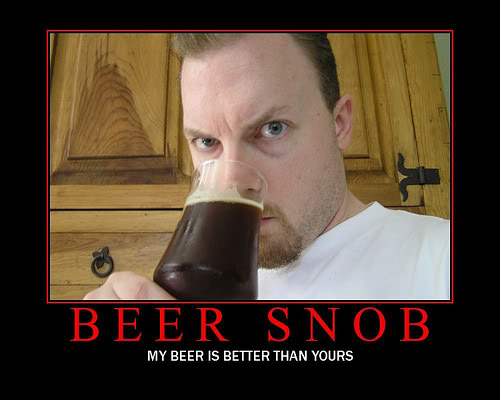
beersnob

If a beer is well made, it is well made. I don't care if it is a homebrew, a local nano-brewery brewing out of a garage, a "too big to be cool craft" brewer, or even a macro from AB InBev. People who won't drink or say a Boston Lager or Guinness Draught suck because of their own preconceptions just shouldn't be taken seriously. If you have valid and informed reasons why you don't like a beer I have no issue with it. There is a reason why stores, bars, and restaurants have more than one beer in stock. Too many beer drinkers can't or won't; sadly asking people to be honest and open-minded is often too much to ask for.

Tuesday, November 25, 2014

Taking the BJCP Exam

I made it to the Rising Tide brewery where the exam was held about 5-10 minutes before the exam was set to begin. The only seat left was at a table in the front of the space in the brewery set aside for the exam. As the exam began, I looked over to my left and saw three people at that table start their evaluation of the beers and whip out the BJCP Guidelines. I didn't realize the exam was open book, so I pulled out my iPad and opened the BJCP app to reference the style guidelines as I judged the beers.

The gentleman administering the exam then walked by, said the exam was indeed closed book and took my iPad and iPhone. I felt like a kindergartner whose toys had been taken by his teacher. Evidently I was sitting next to the exam proctors who are supposed to have the answers.
Will this be me?

The exam itself consisted of judging six different beers. Since the exam was clearly closed book I was fortunate that I was familiar with all six of the styles. When judging beer in a competition setting style adherence is clearly important. When the exam is graded the proctors will be looking at the descriptiveness of the comments, what off-flavors or defects in the beer did the exam-taker (me) notice or not notice, and what if any suggestions to improve the beer were offered. As I studied for the exam, the feedback on the scoresheet seemed to be what separated the good scoresheets from the better ones.

The actual beers at the exam can be a curious mix of beers. If the exam consisted of six commercial and/or award winning homebrew beers it would not be the best way to evaluate a prospective judge's ability to notice flaws. Two of the beers I tasted were well known commercial beers that had been altered so that they would taste like they had obvious defects. One was a blend of three different homebrewed beers that were each six months old. There was one unaltered homebrew that I thought was excellent and gave a 39, and there was an unaltered commercial beer that as soon as I found out what it was kicked myself for being overly critical in my comments and giving it a score in the mid 30s. Just like a competition, the condition of the beer when it is served is out of the brewers hand. I think all the beers we judged came out of growlers and were on the flat side which can certainly effect the aroma, mouthfeel, and flavor of a beer.

After the exam I mingled a bit with the other exam takers and the exam administrator. Speaking with them made me feel like I did okay on the exam. If I finished with a score of 70 or higher I will be attain the rank of a Recognized BJCP judge. From there based on the exam score and accruing experience points judging at competitions, a judge can move up in rank from there. It is also possible to retake the exam to try and obtain a higher score and ranking.

It can take several weeks or even months to receive the results. These are people with jobs who do this in their spare time. If I pass the exam I can see myself judging locally at competitions. I don't think I see myself taking Written Proficiency Examination or aggressively trying to move up the ranks, but if I find I enjoy judging who knows? If the experience can make me a better brewer that was always my main intention. I certainly think that it has.

Follow me on Instagram @wouldbebrewmaster
Like The Would-be Brewmaster on Facebook
Share what beers you are drinking with me on Untappd

Friday, November 21, 2014

Judging at the Best of Boston Homebrew Competition

As preparation for my upcoming Beer Judge Certification Program (BJCP) tasting exam in Portland this weekend, I judged at the Best of Boston Homebrew Competition last weekend.

bob2014-1024x416


My only previous judging experience was at the Boston Homebrew Competiton run by the Boston Wort Processors Homebrew Club. That day I judged stouts in the morning, and light hybrids in the afternoon. This time around I wanted to experience brewing something completely different, and was assigned to Belgian ale in the morning and American ale in the afternoon. The former consisted of saison, bier de garde, and Belgian specialty, a kind of catch-all for any Belgian beer that did not conform to any particular style. Having brewed none of these, I made sure to study in the days leading up to the competition.

Thursday, November 6, 2014

Beer competitions and becoming a judge

Competitions are an important for the homebrewer, especially a "would-be" like myself. It is not always easy to get constructive feedback on your beer. Most of my friends aren't hardcore craft beer aficionados. When you share your homebrews with a Bud Light drinker he/she will probably say the beer tastes like a Sam Adams because it is likely the only beer that the person can think of that has actual flavor. Even when you share your beer with a beer geek, if he/she isn't familiar with the brewing process he/she won't likely be able to offer any advice to improve you beer.

Certificate_of_Completion
Passed on the first try! Boom!

Most competitions are use Beer Judge Certification Program (BJCP) judges, scoring, and style guidelines. Not all of the judges who judge your beer are certified by the BJCP. Any brewer or beer lover who feels like he/she knows his/her stuff can judge a competition as a novice judge. The competition organizers will pair or group a novice judge with an experienced or certified judge(s) to provide guidance. My girlfriend and I volunteered as novice judges at this past Boston Homebrew Competition (BHC) organized by the Boston Worts.