Thursday, October 20, 2022

Tasting Notes: Curly's Pumpkin Milk Stout 2022 (30A)

The experience of doing short and quick written evaluations on three American Wheat Ales using BJCP criteria of aroma, appearance, flavor, mouthfeel and overall impression was instructive. I decided to do something similar with this batch of Curly's Pumpkin Milk Stout. I didn't go out of my way to evaluate commercial examples, but I did jot down thoughts on my beer.

Leaves just starting to turn. Feels like fall.

Aroma: Fall spice at first, clove slightly strongest. Some roast and earthy hop as it warms. 

Appearance: Opaque black. Moderate creamy tan head with good retention. 

Flavor: Spice not as present as in the aroma, doesn’t dominate base beer. Slightly bitter dark cocoa and French roast coffee malt flavor with some underlying sweetness. Medium earthy hop flavor and moderate bitterness. Fermentation fairly clean. 

Mouthfeel: Med full body, quite creamy. Medium low carbonation. Roast dries out finish. 

Overall: Really enjoyable and drinkable; not a meal in a glass. Not as smooth as I remember prior batches being. Clove does dominate the spice blend. May want to readjust. 

Much better head retention than some 
earlier batches.

The Muntons Chocolate Malt I used in this batch is much darker than the Briess Chocolate Malt I used in my last batch. Next time I will probably use Muntons Light Chocolate to try and get a smoother malt flavor and a sweeter finish. 

I will also fine tune the spice blend. The clove is subtle. I've brewed beers with clove that were almost phenolic. You don't get that here, but you do taste the clove more than the other spices. There's no heat from the ginger or cinnamon. The cinnamon doesn't linger on the palate like a lot of fall beers which I like. This recipe uses twice the amount of cinnamon as it does clove and nutmeg. I might do something like 3/4 tsp cinnamon, 1/2 tsp nutmeg and 1/4 tsp clove. 

Follow me on Instagram  @wouldbebrewmaster
Like  The Would-be Brewmaster on Facebook 

Friday, September 23, 2022

Rebrew Day - Curly's Pumpkin Milk Stout

There were a few reasons why I decided to re-brew Curly's Pumpkin Milk Stout. I had not brewed any variant of Curly's Milk Stout or a Pumpkin Beer of any kind since my last batch in 2016. I also haven't had a dark beer on tap in several months. The timing just felt right. I also was too busy over the summer to brew a Marzen or a Festbier and let them lager properly. 

I stayed fairly close to the original recipe. I used American 2-row, Maine Malthouse Mapleton Pale specifically, as the base to help convert the starches in the pumpkin to fermentable sugars. I did replace the specialty malts with Muntons Crystal 110 (40L), Chocolate Malt, and Roasted Barley. I didn't have a chance to pick up the 1272 yeast from the last batch, so S05 will have to do and I'm sure will work fine.

Picked up sugar pumpkin at a local farm.

Thanks to Jennie for helping cut the pumpkin.


Roasted the pumpkin on the grill outside.

Obligatory grist picture.

Sparging the mash with pumpkin in it. 

In 2016 pumpkin beer was already trending down. Six years later the trend has continued. In the late 2010s marzen made a big comeback. It feels like every brewery has some kind of Oktoberfest event. This year it seems like more brewers are making the lighter, contemporary German Festbier style for the fall. Sam Adams has one of each in their sample pack. 

At the height of the pumpkin beer craze I wasn't the biggest pumpkin beer fan. I remember going to one pumpkin beer tasting and by the end all I could taste was cinnamon. I still enjoy well-made versions. One of my favorites was Cape Ann Brewing's Fisherman's Pumpkin Stout, and its big brother Imperial Pumpkin Stout. With Cape Ann no longer in business I did consider using an American Stout base, but it was past time to bring Curly back. 

Follow me on Instagram  @wouldbebrewmaster
Like  The Would-be Brewmaster on Facebook 

Wednesday, July 20, 2022

Tasting Notes: Summer Somewhere (2022) 1D American Wheat Beer

Summer Somewhere has been the summer seasonal beer at my home brewery since 2015. I have described Summer Somewhere as being the same British Golden Ale recipe every year but with completely different ingredients. It really is a horrible way to describe applying the same recipe framework in terms of the same starting gravity, hop bitterness, and hop schedule, but changing the base malt, hops and yeast every year. 

For my Homebrew Con seminar I brewed a variation of the 2020 vintage of Summer Somewhere. One adjustment I made was using a Maris Otter Extra Pale base, but added a small percentage of Caramalt 30 to match the color of the 2020 beer which was made with a darker base malt. 

As this summer approached, I was thinking about how much seasonal beer has changed. Summer in particular was the domain of lighter styles like Blonde Ales and American Wheat Beer. Often these styles were lightly hopped and flavored with fruit or citrus like Samuel Adams Summer Ale, or were hopped a bit more aggressively with a moderate spicy or citrusy hop flavor like Riverwalk Screen Door. 
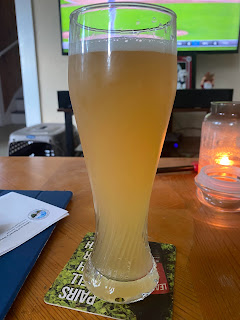
The American Wheat Beer style used to be a lot more common than it is now, both in the summer and in general. Here is a rundown of the commercial examples cited by the Beer Judge Certification Program (BJCP):

  • Widmer Hefeweizen: One of the archetypes of the style. This beer used to be made at the old Redhook brewery in Portsmouth, NH. That facility is now the Cisco Brewery, and this beer is nowhere to be found in the northeast.
  • 312 Urban Wheat Ale: Last time I had this beer was at a Goose Island bar at O'Hare Airport in 2017.
  • Boulevard Unfiltered Wheat Beer: This was the beer that made Boulevard. The beer's presence in the local market has faded like Boulevard has.
  • Bell's Oberon: It's huge following in Michigan guarantees this beer isn't going anywhere.
  • Harpoon UFO Hefeweizen: Not listed by the BJCP, but the first example I remember. Local bars used to serve it with a lemon wedge. I don't believe the beer has been discontinued, but I couldn't tell you the last time I saw it. Not being able to find it in awhile was one of the reasons I wanted to brew the style. 
For 2022 I decided for Summer Somewhere to make my own American Wheat Beer. My recipe was pretty straightforward: 66.6% Maris Otter Extra Pale, 33.3% Wheat Malt, homegrown Centennial hops, and American Wheat yeast (likely sourced from Widmer).

When the beer was done and I tasted it for the first time, I really enjoyed it. The more I drank it, the more I started to believe something was missing. It was good, but felt like it might have been missing the mark in some way. Maybe the hop bitterness and flavor was too low. Using homegrown hops exclusively is a bit of a trial and error since you don't know what the alpha acid percentage is.
I decided to see how my beer compares to some commercial examples of the style. I visited my local Total Wine and found exactly two examples of the style. There were a lot more Belgian-style witbiers, or blonde ales with little or no wheat in the grist. When I shared this experience on my Facebook page, a couple commenters said it was because American Wheat Beer is not a style they enjoy. 

For this beer I wanted something easy drinking, with a citrusy hop flavor without feeling like a New England IPA. I targeted 20 IBUs, and had equal hop additions at 60 minutes, 10 minutes, and 15 minutes in the whirlpool. 

The two examples I was able to find were Oberon and Shipyard Summer Ale, a beer I had cloned previously. I poured all three beers in taster glasses and did a side-by-side. I jotted down some quick thoughts on all three beers, taking notes on aroma, appearance, flavor, mouthfeel, and overall impressions. Same criteria as a BJCP scoresheet, but not as detailed as if I was judging in a competition. Since my objective was to compare the beers and not determine the best beer, I didn't score the beers.


Shipyard Summer Ale
Aroma: Bready, toasty malt. Spicy hops
Appearance: Light copper, brilliant clarity. Foamy white head with good retention 
Flavor: Smooth and slightly rich malt flavor. Citrus and spicy hop flavor. Floral esters high and add a nice complexity. 
Mouthfeel: Med body, med-high carb. Finish slightly dry. 
Overall: Nice blend of malt and hops. Like a summery best bitter 

Oberon 
Aroma: Doughy wheat, hint of citrus
Appearance: Hazy gold. Foamy head with good retention 
Flavor: White bread with a hint of maillard sweetness. Med low floral & spicy hop flavor
Mouthfeel: Med body, Med-high carb. Finish fairly clean and crisp, zesty 
Overall: Smooth and citrusy. 

Summer Somewhere 2022
Aroma: Lemongrass, bread dough and crust 
Appearance: Straw, hazy but not opaque. Foamy white head with good retention 
Flavor: Doughy up front and finishes with some light toast. Hop flavor low, some citrus. Bitterness is low, beer malt-forward. 
Mouthfeel: Creamy, medium carb. Neutral finish 
Overall: Clean and easy drinking. A little bland compared to the commercial examples. Could use more hop flavor and bitterness to add some zip. 

Tuesday, July 5, 2022

Time to fill them kegs!

My last successful brew was August of last year. American Stout is a style I had wanted to tackle for awhile. Compared to Irish Stout, American Stout is higher in alcohol and often has an American hop presence. Once a staple of American craft brewing stalwarts like Sierra Nevada, the style is a bit harder to find these days. This was an example of designing a recipe and nailing it on the first try.

My next attempted brew was several months later. I designed a Christmas Ale recipe using Muntons Connoisseurs Nut Brown Ale extract beer kit as my base. The samples I pulled from the fermenter missed the mark. Then before I could keg the beer, a pelicile formed and the beer was infected. 


Earlier this year I had a double brew day: an all grain Hazy IPA and extract Irish Stout. The IPA was super grassy and undrinkable. I blame this on using old hops and dry hopping for too long. I procrastinated kegging the Irish Stout, and that ended up getting infected like my Christmas Ale. Both batches were drain-pours. I also made a yeast starter for a saison I never brewed, and bought a pitch of yeast for the 2022 Summer Somewhere that is still in my fridge. 

As summer began, my kegs were empty. My favorite time of year and I had no beer to drink. One reason why I brewed so little, and was so unmotivated to package what beers I did make was how cluttered my basement had become. Come May I had to make beer for the Muntons booth at Homebrew Con. That meant I had to do some long overdue spring cleaning and make some beer.

For the booth I made the following:

  • Two Muntons Flagship Hazy IPA kits. These hopped extract kits were easy to make on brew day, just dissolve the kits in water.
  • A ten gallon, partial-mash Hazy IPA made with Muntons new Oat Malt Extract. This was a fun brew. I brewed this with a 5-gallon partial boil, added the Oat Extract at the end of the boil to sterilize, and topped off with 5 gallons of water to get 10 gallons.
  • A 10 gallon all grain Hazy IPA. This was actually my first 10 gallon all grain batch I've brewed at home. 
  • A 5 gallon partial mash Passion fruit Sour made with Muntons new Sour Malt Extract
  • A 5 gallon Vienna Lager made with Muntons new Vienna Malt Extract. 
In all it took me four days to brew all of this beer. The idea for the three different Hazy IPAs was to do a side-by-side at the booth. This beer needed to be in kegs three weeks before the show to have time to keg condition. After I was done brewing all of these beers for work, I gave my cooler mash tun, Brewers Edge Mash & Boil, 15 gallon kettle, and 8 gallon kettle a deep clean. Four days to make 40 gallons of beer for our booth. That wasn't all the beer I made for Homebrew Con either.

Earlier this year I submitted a seminar proposal to the American Homebrewers Association, which was accepted! If you follow my social media you may have seen that I will be giving a seminar on brewing English Ales. The rationale and motivation behind the seminar deserve it's own post, so I won't go into it here. As part of my seminar I could request beer service. Being able to taste recipes from the seminar, that apply my philosophy in brewing English Ales made too much sense not to do. Lets be honest, a seminar with beer is usually better than a seminar without beer.

Hearkening back to my days brewing in an apartment on an electric stove, I brewed four different 3 gallon brew-in-a-bag batches. I was able to brew these over two separate double brew days. Not sparging did impact my mash efficiency, but the time savings was worth it in this case. I will package these in my three gallon kegs and force carbonate them before driving from the Boston area to Pittsburgh. 

That is 52 gallons of beer, in 12 corny kegs, that I made for and will be driving to Pittsburgh in my Hyundai Elantra. Hopefully I have room for my suitcase, CO2 tank, and jockey box. After all that, when I wanted a beer I had to go to the store. What a sorry state of affairs.

At least all this brewing gave me the impetus to clear out my brewing area and get back into a groove with brewing. If I want homebrew to drink for Independence Day and the rest of the summer, now is the time. Time unfortunately is not on my side. My VP wasn't thrilled I needed as much time to make all this beer for our homebrew team based in the UK. I can squeeze in one more brew day before the show. To make the most of that time I came up with a plan. 


If there is one lesson that was reinforced brewing all of those beers for Muntons was how much of a time saver beer kits and extract brewing can be. I bought the Conneseurs Wheat Beer Kit and a can of Extra Light Malt Extract to re-brew a version of one of my favorite batches from a few years ago. I also have an extra can of the Muntons Sour Malt Extract I will combine with the Extra Light for another batch. Finally I will brew the 2022 vintage of my annual Summer Ale, Summer Somewhere.

By getting these in fermenters before the show, they will be ready to keg when I get back. No need to load up on Summer Shandy, Narragansett or Gennessee Cream Ale.