Friday, May 6, 2016

Discoverering a German legend, Das Kölsch!

In my role with Newburyport Brewing, I post occasional blogs on their website. I wrote this post about the brewery's latest year round beer, Das Kölsch. We tried it for the first time at the release party at the Port Tavern in Newburyport, and I loved it! Light, crisp with a low floral flavor balanced by a light bready malt flavor, it is a beer anyone can enjoy.

discoverering a german legend, das kölsch!

Kölsch is a style I really enjoy. It's a style I've brewed a couple of times before I started the blog. The flavor is so delicate any off flavors become evident. The challenges I've always run into brewing kölsch is fermenting in the low 60s and then lagering.
The cold fermentation temperatures ensure the clean and crisp flavor. Even though kölsch is an ale, traditional examples are lagered at cold temperatures. This helps reduce sulfury flavors that can be produced when a beer is fermented at cold temperatures.
Kölsch is supposed to have brilliant clarity. The traditional German Ale strains don't floccuate well either. Without cold crashing the beer before packaging, there is no chance that the finished beer will have the clarity it should.
Until I have the ability to brew a kölsch and get it right, Das Kölsch will be here for me!
Follow me on Twitter @JChalifour
Share what beers you are drinking with me on Untappd

Bottling Day: Fort Dummer (American Pale Ale)

One of my favorite local beer blogs is Hoppy Boston. For the most part it is a very simple blog. It’s just a guy, Ryan Brawn, who lives in the Boston area reviewing a beer. Why mess with a winning formula?
Recently Ryan wrote a post about a house beer. A house beer is a beer that you usually have on hand at home. I am working through a backlog of beer at my house. I love this concept. As a beer drinker it is too easy to be caught up in the latest and greatest, while taking the classics for granted. After going to three Red Sox games last month, and a vacation planned for June, my plan is to spend as little money in May as possible. When I have space and more disposable income, I am going to make sure to have a couple of commercial house beers. Right now I am thinking it’ll be a six pack of Newburyport Pale Ale, Notch Session Pils, and one seasonal beer.
For my homebrew, Curly’s Milk Stout has been my house beer for a while. I am still tweaking and trying to perfect the recipe. Recently I did a vertical of every batch of Curly’s that I have brewed. Jennie and I split the last 22 ounce bomber from the original, one gallon batch. That was the version she liked the best. So much for continued improvement. The beer keeps extraordinarily well. It is slightly hop-forward for its style with a late addition of Fuggles hops. This character fades over time, but there is enough malt complexity to compensate.
When I just want to have a beer, I don’t find myself going for Curly’s Milk Stout. I realized I needed a sessionable pale ale to have as a second house beer. After visiting the new Trillium Brewery in Canton, I spent a small fortune. It would certainly be cheaper and easier to have a juicy pale ale of my own at the house.
I originally brewed such a beer for the Ales for ALS Homebrew Competition in Essex, Fort Dummer. I loved that beer when I brewed it. I even hoarded the last couple of bottles, and the flavor kept quite nicely even after a few months. Since I am primarily brewing this beer for the house I brewed a three gallon batch. This would also give me plenty to bring to homebrew club meetings, enter into competitions, or just share with others. This is also a beer I want to drink when it’s fresh.

My original plan was to use the 1084 Irish Ale yeast I harvested from BeerSmith’s Dry Irish Stout, and subsequently used with Pyrite Pistol and Banshee Breakfast Stout. I ended up putting off this brew day for quite awhile and decided to buy a fresh package of yeast. I went with 1318 London Ale III. I love this yeast. I originally used it in the first batch of Curly’s Milk Stout and several English beers. Many craft brewers in the northeast use 1318 in hoppy pale ales. The yeast gives the beer a softer mouthfeel, and its fruity esters compliment fruity American hop varieties.
I scaled up my starting gravity of the beer to try and get the alcohol by volume over 5%. When the homebrew shop did not have any whole leaf Ahtanum hops, I substituted Citra just because. I flipped the dry hops to a degree; I added the whole leaf Citra during active fermentation to see if the expanded contact surface for the yeast would give the beer a juicier flavor. I racked the beer off the Citra after five days into a new vessel. I had planned to add a huge second dry hop five days before packaging. One day before I planned to bottle, I saw two packages of hops in my freezer that I forgot to add. I really need to label my hop additions. I think I will use these hops to brew another batch of Alan’s Stepchild.
I had been meaning to brew this up for weeks. I finally got around to it the same weekend as the Westbrook Gose debacle. That is probably why I never got around to posting a brew day post. I didn’t notice the oversight until after I bottled the beer!
Even though my second dry hop was less than an ounce, the beer still had a beautiful hop aroma as I bottled it. If this is going to be one of my house beers, I can always do a bigger dry hop next time. I can’t wait to crack one open in a couple of weeks.
See the full recipe here.
Follow me on Twitter  @JChalifour
Share what beers you are drinking with me on  Untappd

Wednesday, May 4, 2016

A beer drinker’s guide to Fenway Park

The Toucher & Rich show on 98.5 The Sports Hub ran their March Badness bracket, a bracket of the worst of Boston sports. This year’s winner was $10 beers at Fenway Park. I’ve been to three games at Fenway this year. The beers aren’t quite $10. At most stands it’s $9.25, or $9.75 for “craft”. Craft is in quotes because several of the beers that are marketed and sold for “craft” prices do not meet the Brewers Association’s definition of craft.

Nice night at the ballpark!

What I am not going to do is whine about beer prices. Yes, beer prices are obscene, but as a capitalist it is up to me to choose whether or not to voluntarily exchange my $9.75 for a beer. If the club decides that they would make more money by selling more beer for a lower price, they will lower prices. If they think that high beer prices are hurting attendance, they will lower the price of beer. I know my bank account didn’t take such a beating after going to three games in April, I would be more inclined to go to more games the rest of the season. That is a business decision for the Red Sox to make.

Two years ago the Washington Post conducted a thorough ranking of the best and worst beer selections at all 30 MLB ballparks. At that time the Red Sox ranked 22nd. In the past two years my hunch is that draught offerings have gotten worse.

Wednesday, April 27, 2016

Brew Day: Wisconsin Belgian Red Clone (Fruit Beer)

Two years ago we traveled Jennie's native Wisconsin to visit her family. Her family lives in Chippewa County, about a twenty minute drive from the Leinenkugel's Brewery in Chippewa Falls. During our week in Wisconsin we did as much sight-seeing as we could. We visited the Leinie Lodge and toured the historic Leinenkugel's brewery, we drove across the state to Green Bay to take a tour of Lambeau Field. On another day we drove even farther to the tiny town of New Glarus to stop by the New Glarus brewery.

According the the Brewers Assoication latest Top 50 ranking of craft brewery sales, New Glarus is the 20th largest craft brewery in America. New Glarus ranked ahead of brewers like Abita, Anchor, Victory, Long Trail, Shipyard, Rogue, Left Hand, and Allagash. What makes this astounding is that New Glarus only distributes in the state of Wisconsin. The slogan on the main page of their website is literally "Only in Wisconsin"
Capture
Last year a bar in neighboring Minnesota bought several kegs of New Glarus' venerable Spotted Cow in Wisconsin, put it on tap at the bar, was caught doing so, and the owners are facing criminal charges.
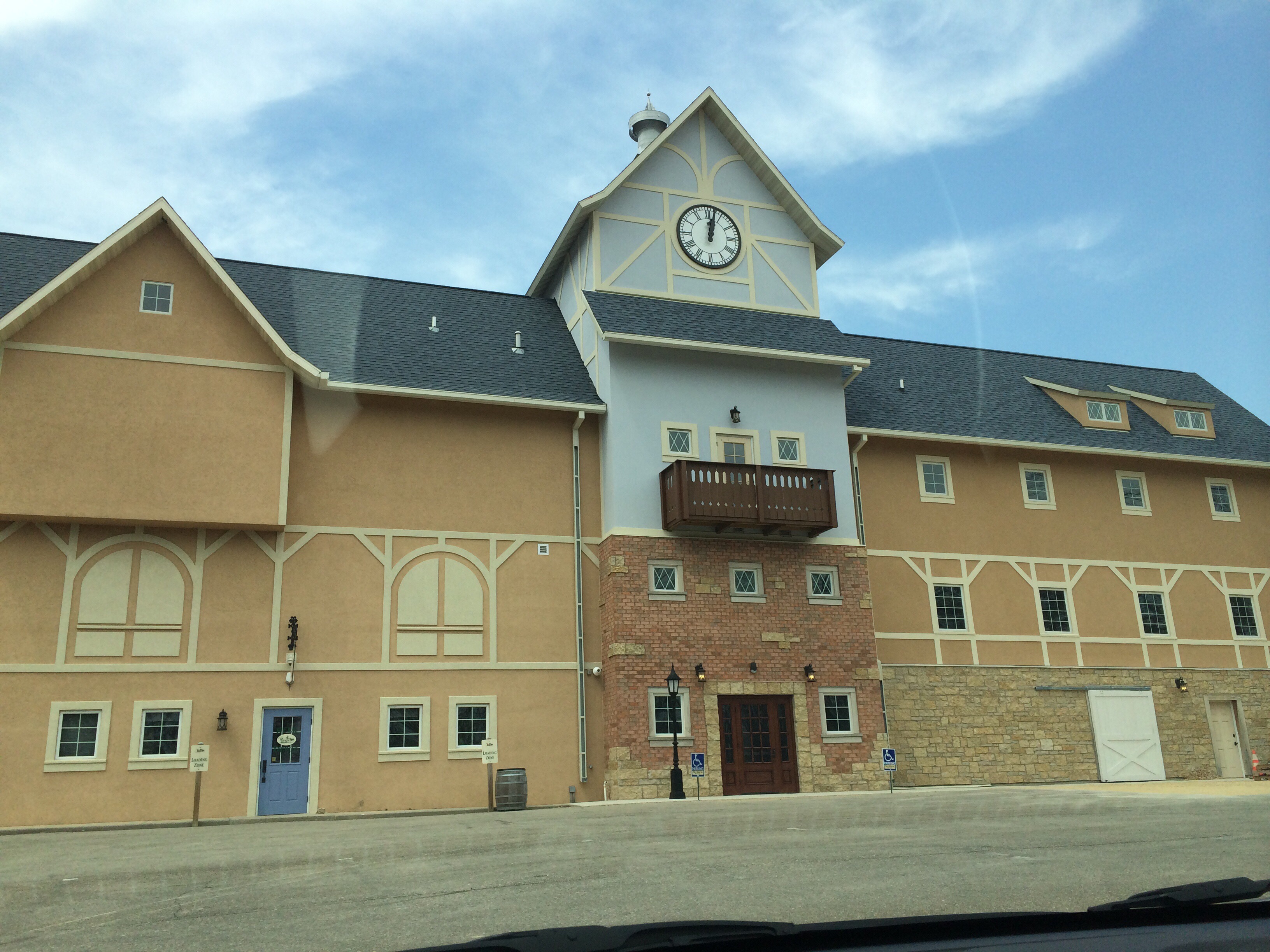
The drive from Jennie's parents house to the brewery was around three hours. The massive and immaculate brewery is on top of a large hill. The town of New Glarus is named after the Swiss village of Glarus. Both the town and the brewery have a distinctive Alpine character. The brewery looks like a giant cuckoo clock.
We enjoyed a sample flight, went on the self-guided tour, and bought a ton of beer to take home. I carefully loaded 18 bottles into my checked bag. It felt like it was full of bricks. All of the beer made it home safely, and there was a nice note from the TSA that my back had been "randomly" checked.
Out of all of New Glarus' beers, my favorite might be Wisconsin Belgian Red. It is a crisp, super drinkable cherry beer that perfectly straddles the line between a cherry beer and a cherry wine. When I told Jennie I was going to brew Broken Fist IPA for my cousin Adam, she correctly pointed out that I would also need to brew a beer for Adam's wife Kristen. I know Kristen enjoys ciders and fruit beers. This is the perfect opportunity to brew a clone of Wisconsin Belgian Red.
Unlike BrewDog and Stone, New Glarus is notorious for carefully guarding their recipes, ingredients, and brewing processes. Co-owner Daniel Carey has in the past said he did not want to disclose any "trade secrets". The brewery's guarded nature, and stubbornness in only distributing in Wisconsin, has only enhanced their mystique.
Luckily for me Amahi Turczyn Scheppach published a clone recipe in the July/August 2007 issue of Zymurgy. Using the volume of cherries New Glarus uses in the commercial version would be quite expensive. Scheppach added cherry juice to his beer to avoid having to clean and pit ten pounds of fresh cherries. He played around with the ratio of cherry juice and beer to get a pronounced cherry flavor, aroma, and color, without spending a small fortune on cherry juice.
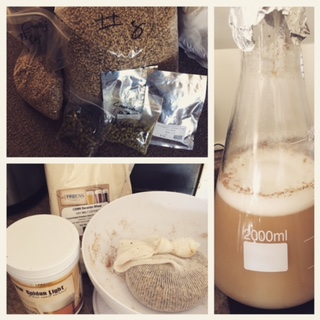
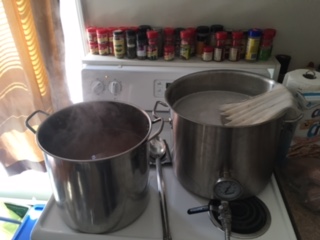
I brewed the beer the same day as Broken Fist IPA. To save time I brewed an extract batch. With all of the cherry juice that is going to be added, the beer would have been dark even if I brewed it with all-grain. I steeped my specialty grain for this beer, started mashing Broken Fist as the Belgian Red was starting to boil. I dumped my concentrated wort into the fermenter just in time to transfer Broken Fist into my boil kettle.
IMG_0082 IMG_0083
I chose a dry yeast, Safbrew T-58. I haven't any witbiers since last spring, or other Belgian styles since the previous summer. I didn't make time to build up any yeast from my yeast bank. I'm also interested to try the dry yeast and see what kind of yeast-derived flavors I get. The wort was fermenting within several hours. Dry yeasts can lag up to two days, so I'm impressed already. The quicker a beer starts fermenting, the better.
If I serve this on Memorial Day, I won't have time to lager the beer on oak like New Glarus. This beer was so easy to brew, I could easily make it again and age it on the oak. I did make a five gallon batch. I'm kegging three gallons for Memorial Day and saving two gallons for us.
To view the recipe in the July/August 2007 issue of Zymurgy, join the American Homebrewers Association for a free subscription to the magazine and online access to the Zymurgy archives going back to 2000.
Follow me on Twitter  @JChalifour
Share what beers you are drinking with me on  Untappd