Tuesday, June 14, 2016

Pilgrimage to Homebrew Con

Homebrew Con, formerly known as the National Homebrewers Conference (NHC) is the American Homebrewers Association's (AHA) largest event of the year. Spanning three days of seminars, exhibitions, and trade shows Homebrew Con is truly an epic event.

When I first learned of the NHC it didn't sound like something I would be interested in. Traveling to another city for a conference felt a little stuffy. I wasn't advanced enough in my brewing that I would want to sit down and listen to highly technical seminars about beer I might not understand. From reading Brulosophy and other blogs, and the BeerSmith podcast it became clear the NHC was not what I thought it was. Other brewers felt the same way which was why the AHA re-branded the NHC as Homebrew Con.
As soon as I saw that Homebrew Con 2016 would be in Baltimore I decided we had to go. I spent the summer of 2004 in the area and looked forward to going back. Baltimore is a manageable eight hour drive which made attending more affordable. The AHA lined up discounted rates at numerous hotels within walking distance of the convention. We were able to book a suite a ten minute walk away for less than $200 a night. When I saw how much it would be to park my car at the hotel we decided to take Bolt Bus down.
In addition to Homebrew Con itself, there were numerous other events going on in Baltimore during convention week. The final round of judging for the National Homebrewing Competition coincides with Homebrew Con week. Additionally the Beer Judge Certification Program organizes several events of its own.
When we decided to go I wanted to do everything! Who knows if I would ever be able to attend another Homebrew Con? The convention was in Baltimore this year and it will not likely be back on the East Coast again for several years. I wanted to make the most of the entire experience.
The week went by so quickly. For two days after it was over I was actually, literally sad. There's a lot to cover. Check this space for all the details this week! 
Follow me on Twitter  @JChalifour
Share what beers you are drinking with me on  Untappd

Wednesday, June 1, 2016

Tasting Notes: Broken Fist IPA (American IPA)

It seems like whenever I brew something that comes out exactly how I wanted, or is at least pretty close to how I wanted, the beer is gone in a day. This was what happened when Andy and I brewed the first batch of Pa's Video Board Lager. The extended Chalifour family kicked the five gallon keg in less than a day. This was also the case with my three gallon batch of Broken Fist IPA. 
I brewed exactly three gallons, just enough to fill one of my three gallon kegs. Without the ability to chill and force carbonate, I added some priming sugar to the keg and carbonated the beer naturally. Even when keg-conditioning I typically like to purge the kegs with CO2 to help the beer maintain as much freshness and eliminate as much oxygen in the keg as I can. Sure enough, my CO2 tank ran out of gas on packaging day. All I could do was fill it up, prime, and hope for the best. 
On Memorial Day weekend I picked up ingredients for my next collaboration with Andy, and swapped out my tank to serve Broken Fist and the Wisconsin Belgian Red clone on Sunday. When I tapped those kegs it was the first time I had tasted the finished product of either beer. I was scared that something went wrong during conditioning and the beers could be infected. I made sure to bring a case of Newburyport beer as backup. 
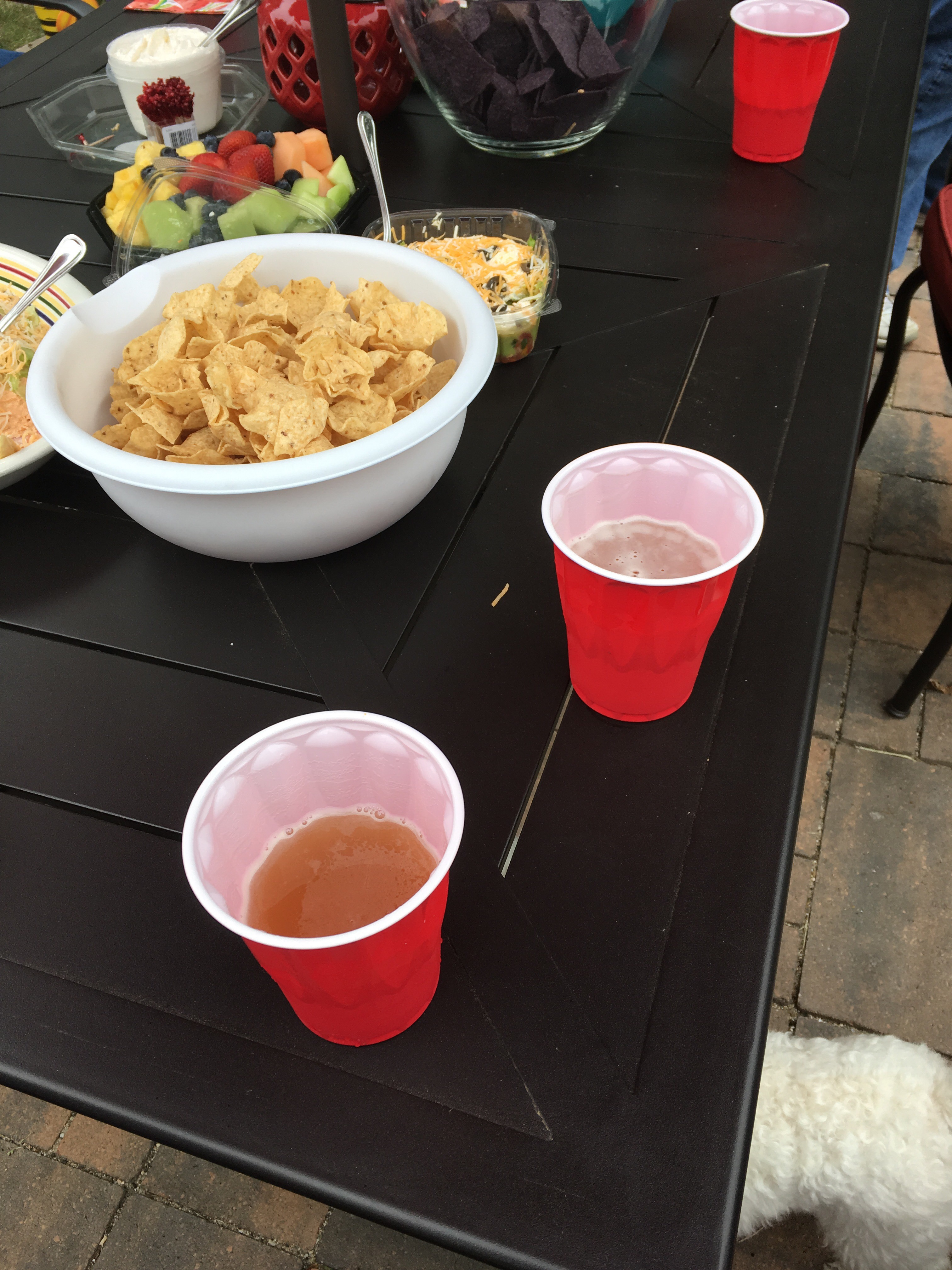
After the first foamy solo cup, the beer had a nice carbonation and hop aroma. I couldn't escape the feeling that the hop aroma would have been more pronounced if I had purged the keg. The beer wasn't too bitter, and had a nice balanced mouthfeel. If anything, the beer could have used a touch more hop bitterness. The hop flavor was citrusy, while the malt provided enough balance. The fermentation character was nice and clean. The hops were the star, and the beer did have a "West Coast IPA" feel. 
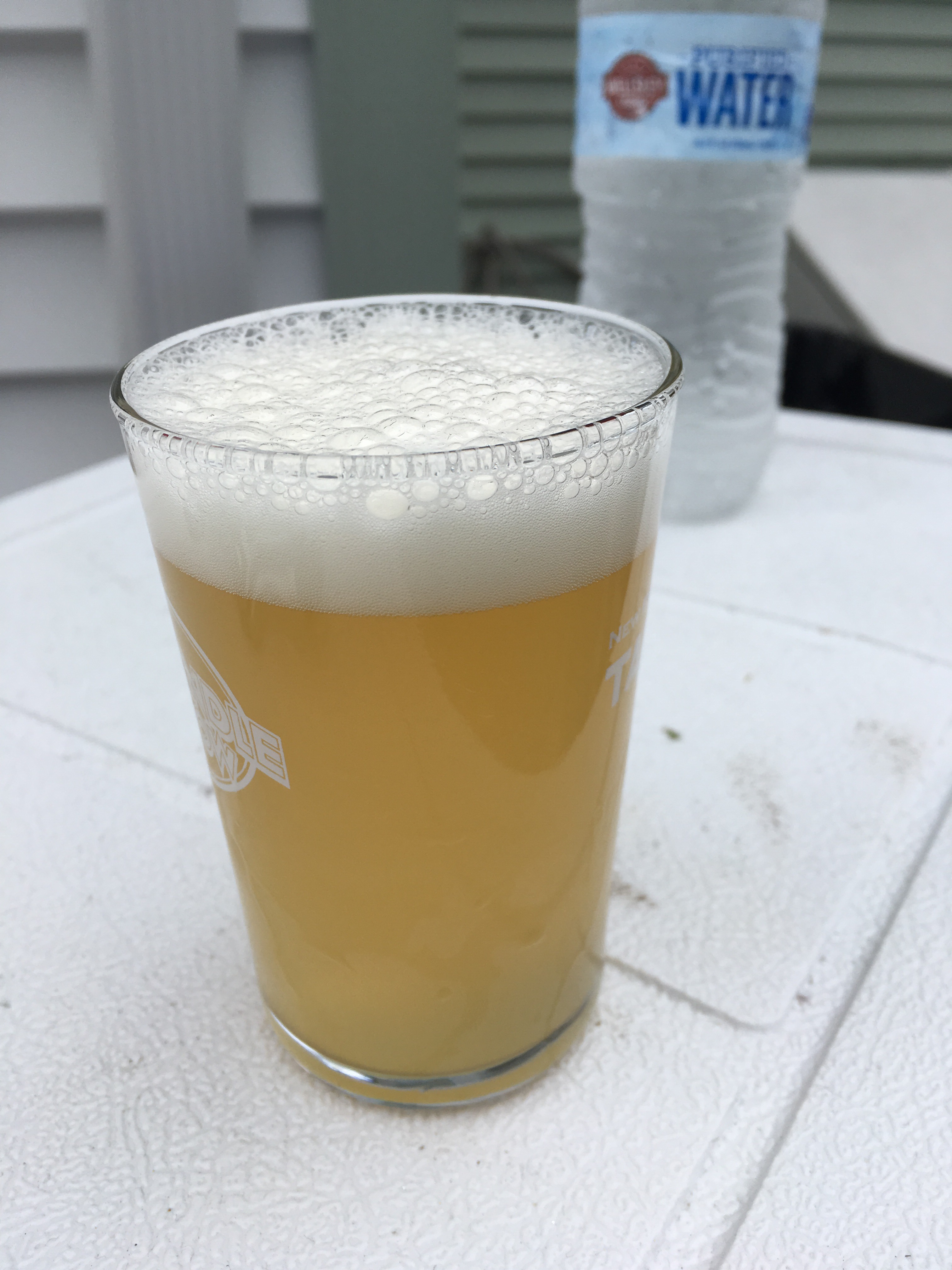
I grabbed a tasting glass so I could see the beer before it was all gone. The color was on point. The clarity was disappointing. I think I need to start using gelatin, or biofine as Jennie doesn't eat red meat. I disassembled my jockey box, and soaked all the lines in a hot cleaning solution. Ideally I would have run the solution through the lines. That might have also caused haze in the beer as well. The beer tasted fine. The appearance is just something the perfectionist in me wants to improve. 
img_0172.jpg
Adam loved the beer. Andy stopped by later on and enjoyed the beer too. My future cousin Corey filled up his red solo cup multiple times. The consensus was this beer is a keeper. I might increase the hop rates a little bit, but the bones of a new house beer are definitely there. 
Give me a hell yeah!
Follow me on Twitter @JChalifour
Share what beers you are drinking with me on Untappd
Friday, May 20, 2016

Tasting Notes: Trans Atlantic Ale (Strong Bitter)

Changes in temperature and carbonation can radically change the flavor and a drinker's perceptions of a beer. When I packaged the Trans Atlantic Ale I bottled four gallons, and packaged on gallon in a plastic polypin like I did with BeerSmith's Dry Irish Stout.
Out of the bottle the beer pours dark copper, with a thin and mousy white head. Clarity was disappointing. This is probably the result of too much hot break material making it's way from the boil kettle and into the fermenter. Meh. I am not trying to win a gold medal at the National Homebrew Competition with an improvised extract kit.
The aroma is a mix of earthy hops and an expressive, floral character from the yeast. The beer starts suggary sweet, but that sweetness becomes thicker the further it goes back in your mouth. It's like the sugar is caramelizing in your mouth. There is sufficient hop flavor and bitterness to ensure the beer isn't too cloying. The finish was quite dry at first. When I drank my first bottle, I double checked the recipe to see what specialty malts had I added. Two ounces of chocolate malt may have been a bit much. This dryness has mellowed in subsequent bottles I have had.
Out of the polypin, with it's lower cask-like carbonation the finish was much more balanced. The relatively higher carbonation out of the bottles enhanced the roasted character more than the "cask" version. Out of my improvised cask the beer was a veritable fruit bomb. I shared the cask at the North Shore Brewers beer camp. The other members there got lots of cherry and gooseberry notes. The beer served in that format served as a canvas for the Windsor Ale yeast to shine. I would certainly use it again without hesitation for any English style.

As an improvised beer I am happy with the results. While not a perfect English bitter, I do think I can apply some of what I learned to future batches in terms of hopping, yeast selection, grain selection, and carbonation. English Bitters and English styles are some of my favorite styles to brew. Fullers ESB would probably be in my dream six-pack. By the time I finish all of the Trans Atlantic Ale I have at home, it will probably be cool enough up on the third floor to ferment with an English yeast at the appropriate temperature. I think it will be time to brew up a bitter of my own.
Follow me on Twitter @JChalifour
Share what beers you are drinking with me on Untappd
Wednesday, May 11, 2016

Brew Day: Summer Somewhere 2016 (British Golden Ale)

In 2015 I planned out my brews. I made a brewing schedule like a commercial brewer. Sure there were some tweaks along the way, but I basically decided what I wanted to brew for when months in advance. I got away from it later in the year when I got into more small-batch brewing.
This year after brewing BeerSmith's Dry Irish Stout, Pyrite Pistol, Banshee Breakfast Stout, and Dawson's Kriek, I've been winging it. I brewed Camp Randall Red for Barrell House Z's competition, Broken Fist IPA and Wisconsin Belgian Red for Memorial Day, but I have another event coming up I need to brew beer for.
Beans N Brews is a similar event to the New England Homebrewer's Jamboree. It is an opportunity for the public to sample homebrew and to support the All Are Welcome community kitchen. As the name suggests the event has an informal homebrewing competition and chili cook-off.  Assuming the weather ever warms up, a refreshing summer ale is a perfect beer to bring to an outdoor festival in June.
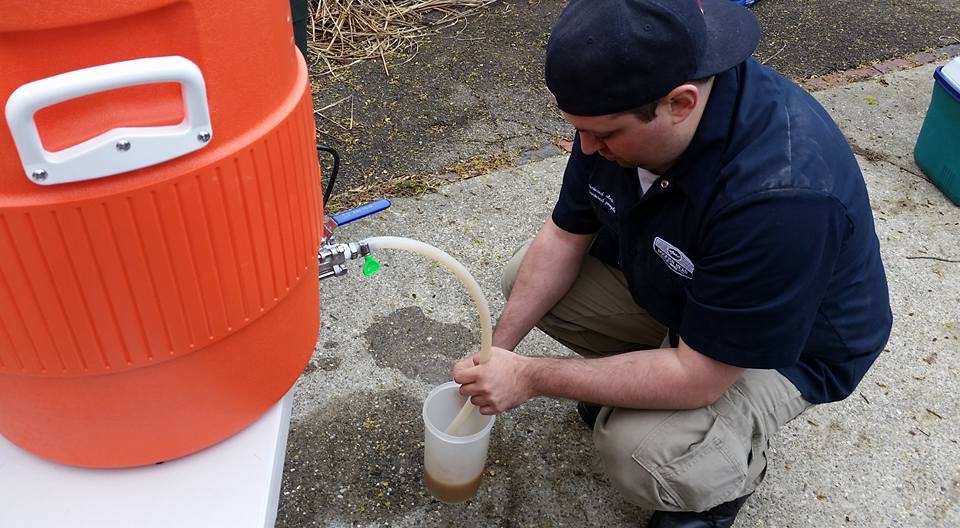
The North Shore Brewers had a beer camp on May 9 on National Homebrewing Day. This is where members of the club get together and actually brew together. Jennie is on board with any brew day that does not monopolize and mess up the kitchen. This also enabled me to brew a five gallon all-grain batch outside.
IMG_0116
 IMG_0121
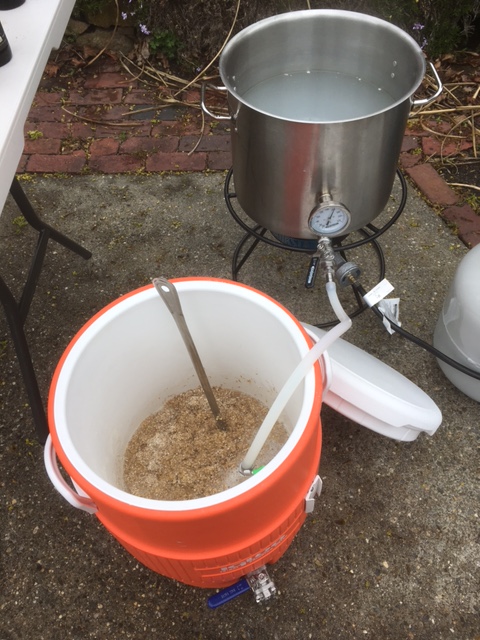
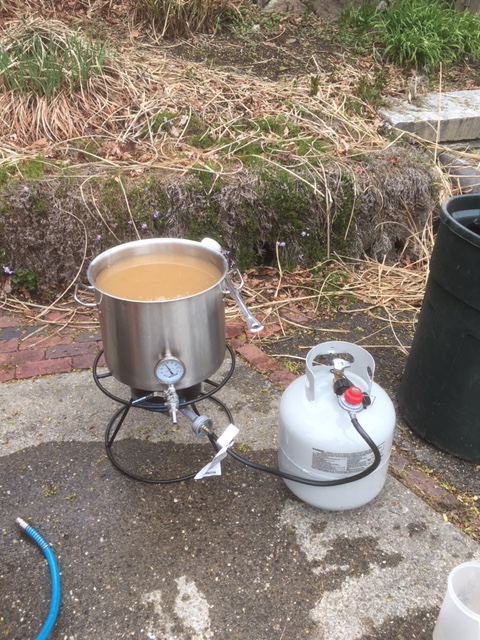
I already had a propane burner to brew outside that I received for free with a previous ingredient purchase. I picked up a propane tank at Dawson's in Beverly. I took advantage of a sale Beer and Wine Hobby in Woburn was having on National Homebrew Day to buy a brand new mash tun for 15% off. The mash tun is a round Igloo cooler with a false bottom. I have read this type of mash tun has better efficiency, meaning better extraction of fermentable sugars, than a cooler with just a screen like when I brew with Andy. I can bring this with me to his house for our next collaboration.
Loading and unloading the mash tun, burner, kettle, propane tank, ingredients, and beers I brought to share was a bit of a chore. It made me wish that when I bought a new car last year that I bought a hatchback or small SUV. Going to beer camps and other homebrew festivals makes me wish I had a bit more cargo space.
Last year I brewed Summer Somewhere with Galaxy hops. I always envisioned using a different hop every year. A British Golden Ale is a very interesting style. The malt bill is most similar to an International Pale Lager, it is hop forward like an American Pale Ale, all while traditionally using an English yeast. A few weeks back I was at the Modern Homebrew Emporium in Cambridge and noticed they had a bin of hops that were new to the shop. One variety that caught my eye was Bobek.
IMG_0119
The description on the package said Bobek works in a variety of styles including ESB and lagers. That sounds ideal for a pale lager-like ale! Grown in Slovenia, they sound similar to Styrian Goldings, which is commonly used in Belgian Pale Ales and other Belgian styles. Styrian Goldings are actually English Fuggle hops grown in Slovenia.
After using 1318 London Ale III in the latest batch of Fort Dummer, it was easy to build up a starter for this batch. The malt is basically the same, except I switched up the base malt with the lightest English base malt I could find locally.
I expect the 2016 version to have a more floral and earthy hop flavor, than the assertive passion fruit flavor the 2015 version hopped with Galaxy. London Ale III is decidedly fruitier than Irish Ale, which will add some complexity.
With a five gallon batch I can keg three gallons for Beans 'N Brews, and bottle the rest for the summer.
Click here for the recipe.
Follow me on Twitter @JChalifour
Share what beers you are drinking with me on Untappd