Homebrew Con 2022 is in the books. Taking place in Pittsburgh, I made the drive from my Boston-area home to mule beer and other supplies for the show. The first in-person Homebrew Con since the Covid pandemic, the show was smaller than in the past. The Craft Brewers Conference, the main industry trade show for professional brewing, was also smaller in scope. From speaking with other vendors, attendance at large festivals and conferences are down across the board. The Pittsburgh RV show only needed one room at the convention center.
The highlight of the show for me was the chance to present a seminar on brewing English-style Ales. I was also working the show with Muntons. While the topic of brewing traditional English styles didn't exactly coincide with the products we were featuring at our booth, this is a topic brewers have asked me about. In the past I struggled to clearly articulate my approach. The process of sitting down and creating a presentation allowed me create a narrative that hopefully made sense.
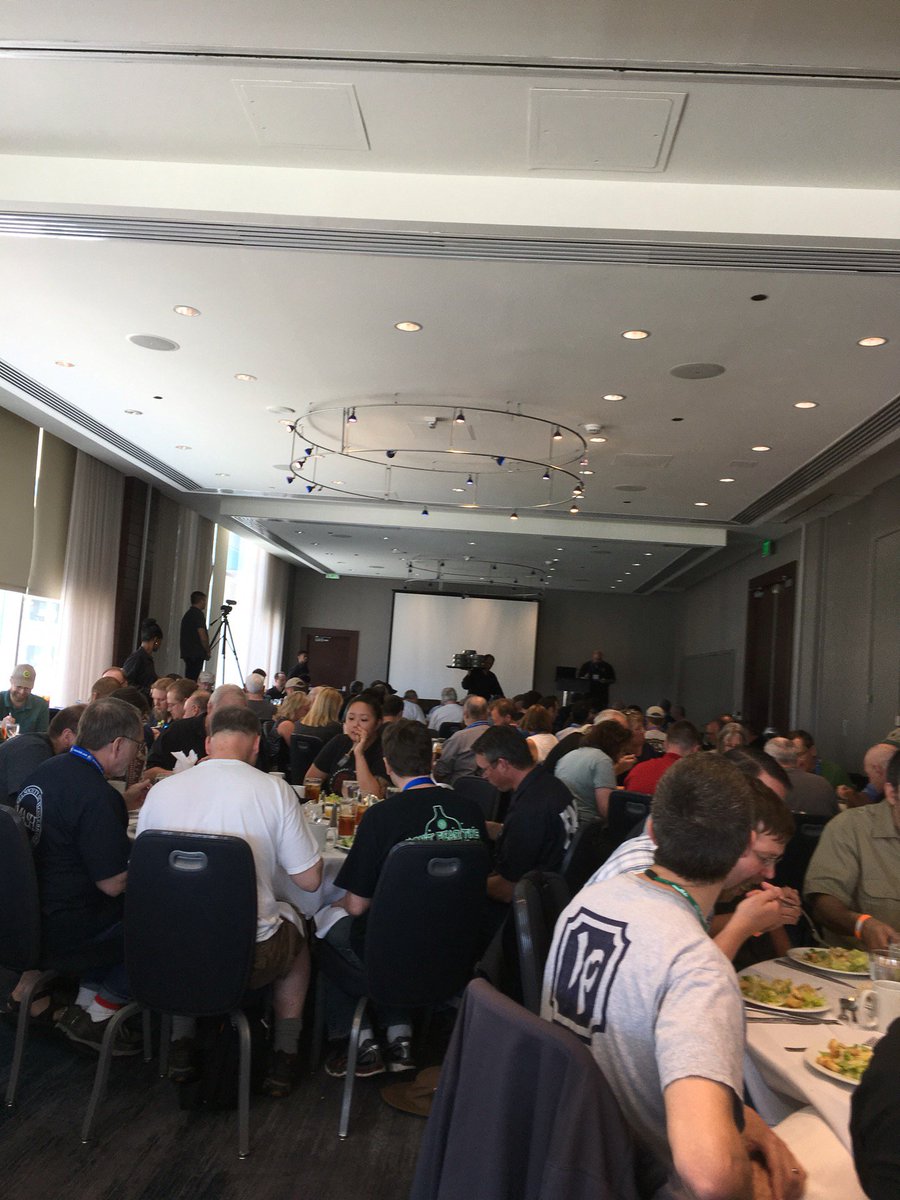
As I put the seminar together, and as I was driving across Pennsylvania I had two lingering thoughts in my head: Would other homebrewers like the seminar and find it informative, and how many people would actually care enough about the topic to show up? Thankfully I received plenty of positive feedback from the talk. As far as interest in the topic, here is a picture taken as I was being introduced:
As a few late arrivals walked in and stood against the wall as all the seats were full. English-styles haven't been setting the world on fire the last several years on the craft beer market. If beer drinkers haven't been buying these styles, would homebrewers want to listen to me talk about how to brew them. The answer at least with this crowd was an emphatic yes.
I brewed four, 3-gallon batches to serve during my seminar. The recipes and my presentation slides can be viewed on the Homebrew Con app. The American Homebrewers Association (AHA) will publish a recording available to AHA members in coming months.
I thought that would be more than enough beer for everyone to taste as I discussed them. That clearly was not enough beer. I don't think anyone was able to try all four beers. Most were lucky to try two, and some attendees didn't get to try any at all. Several people went to the Muntons booth after the seminar hoping to be able to try the beers there.
The Homebrew Expo opened shortly before my seminar ended. Homebrew for Muntons is ran globally out of the UK. The team over there wanted to promote Muntons new Flagship Range of kits and our expanded Ingredients Range of malt extracts. The UK asked me to make the Hazy IPA kit from the Flagship Range, brew the Hazy IPA as a partial-mash with Muntons new Oat Malt Extract, and brew the Hazy IPA with all grain. At the show the plan was to do a side-by-side and challenge brewers to guess which is which.
 |
The grist for the all grain was
75% Craft Pale Malt, 25% Oat Malt |
 |
| Sparging the partial mash Hazy IPA |
I made ten gallons of all three versions. Making two of the beer kits was simple enough. For the partial mash, I used the "Palmer Method" of a partial boil and late extract addition. The all grain was actually the first ten gallon all-grain batch I've brewed at home. I dusted off my old 8-gallon kettle from my apartment brewing days as my Hot Liquor Tank. When that wasn't quite large enough, I heated up some extra water and topped off the HLT during the sparge
To add some variety I also brewed a Passion Fruit Sour ale recipe created by Muntons' NPD Brewing Technologist Nick Piper with Muntons Sour Malt Extract, as well as a Vienna Lager with Muntons Vienna Malt Extract. The lager recipe borrowed heavily from Jamil Zainasheff's recipe from Brewing Classic Styles. The Passion Fruit Sour was a partial mash, while the Vienna was all malt extract.
 |
One can of Sour Malt Extract made a tart beer,
and replaced approx 5lbs of base malt. |
 |
The grist of the Vienna Lager...plus
an extra 0.5 lbs of Light DME |
Our booth was so busy it made it difficult for us to tally responses to the side-by-side. The response was positive. Even brewers who picked out the beer kit, or selected all three correctly tended to need several sips. I didn't see anyone wretch or dump the kit or partial mash beers. The exercise at least demonstrated that brewers can make quality beer with malt extract or a beer kit.
I was really happy with the Passion Fruit Sour. When I kegged it, the fruit flavor seemed to have fermented out. Once the beer was cold and carbonated the fruit flavor was quite nice, if not quite as intense as a commercial brewery adding fruit post-fermentation.
The Vienna Lager was excellent. I didn't have time to lager the beer for several weeks, so it wasn't as clear as a commercial example. The flavor was damn close. The response from attendees was quite strong. One master judge who has brewed the style a lot really liked the malt flavor. His only minor critique was that he wanted a little more hop bitterness.
We had four taps at the booth. The first day of the show we served the three IPA variants and the sour. The second day was the Hazies and the Vienna Lager. We went through the entire keg of Vienna Lager in one day. Having a classic style on tap scratched an itch for a lot of attendees.
As the show wrapped up I looked at the winners of the National Homebrew Competition. For each category the AHA listed how many entries there were for that category. The most entries by category:
- Pilsner - 146 entries
- Strong Belgian Ale - 124 entries
- American IPA - 117 entries
- Fruit Beer - 113 entries
- Pale Malty European Beer - 110 entries
- Amber European Beer - 110 entries
- New England IPA - 110 entries
- Dark European Lager - 108 entries
- Pale European Beer - 102 entries
New England IPA in a three-way tie for fifth. Regular, old fashioned clear IPA was in third. The lager categories were some of the most competitive in the competition.
Most craft brewers I talk to started as homebrewers somewhere along the way. NHC was inundated with lagers, my seminar on English ales was standing-room only, people left the seminar looking for more of the English ales I made for the seminar, and the most popular beer at our stand was a Vienna Lager. Homebrewing has been considered a bellwether for commercial brewing. Is beer-flavored-beer making a comeback? If homebrewing is a leading indicator on where craft beer is going, the answer is yes.
People in beer have been predicting that lagers or classic styles will be making a comeback for years. A lot of it might be wish-casting as craft brewers have continued to pump out
New Englannd IPA. I'm not ready to say with certainty that beer-flavored-beer will make a comeback. I am leaving Pittsburgh with a little bit of hope for at least a modest resurgence.