Nobody likes a flat beer. In my (misspent) younger days I would frequently post-game (continue drinking) after closing the bar (being dragged out of an establishment by an employee of said establishment). I'd crack open a beer after 1:00 a.m. and more often than not pass out before I could finish. I'd wake up in the morning to a flat beer in the fridge that I decided to save for some reason. Finishing a leftover beer like that was never pleasant, but felt like a necessity.
A flat beer is just that flat, a dull, lifeless beverage. Carbonation along with the body of the beer are the two contributors to the mouthfeel of a beer. The textural attributes of a beverage in your mouth along with aroma and flavor are what makes the drinking experience.
A beer with a high level of carbonation will impart a perception of dryness in the finish. This is important in pale and malty styles like saison or witbier to ensure the finish isn't cloyingly sweet. High levels of carbonation can also enhance the aromatics as the bubbles rush to the surface, and the high level of carbonation leads to a thick frothy head like in a German weizen.
A beer with a low carbonation level can have more of a creamy texture and a smoother finish. That can also enhance the more subtle malt and hop flavors. British and Irish styles, especially real ale served on cask have very low levels or carbonation and are served at cellar temperatures. These styles frequently have enough hop flavor or malt character to balance out the finish.
Broadly speaking different styles have different levels of carbonation. As a homebrewer who bottles, the way to adjust carbonation levels is to adjust the level of priming sugar, usually corn sugar (dextrose) added at bottling. For brewers who keg the key is adjusting the pressure from the CO2 tank.
I gave one of my Hot Stove Porters to a friend who had also had The Sustenence. The Sustenence was over-carbonated to the point where it had to be poured very slowly. Even then the beer was still quote foamy. When he had the Hot Stove Porter one of the first things he said was that the carbonation level was perfect. I went for a lower level of carbonation to enhance the roasted malt flavors. There was enough hop flavor and roasted malts to make sure the finish wasn't overly sweet.
Websites like Northern Brewer and Tasty Brew have calculators that make it very easy to know how much priming sugar to add to reach the desired level of carbonation. The standard level of priming sugar to add to a five gallon batch of beer is 4-5 oz. For most common styles like an American Pale Ale, assuming the wort is at room temperature, this works perfectly well. Homebrew shops sell pre-measured packets to boil in water and add to the wort on bottling day. Recipe kits often come with one of these packets thrown in regardless of the style of beer.
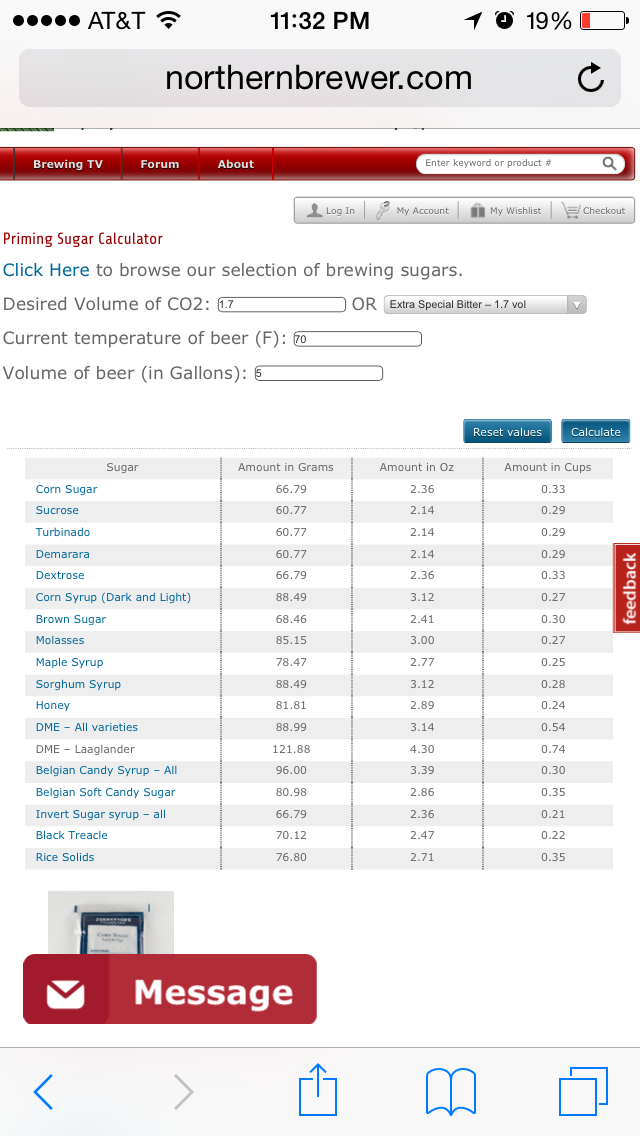
The Welkin Ringer ESB kit from Beer and Wine Hobby that I brewed a few weeks ago came with one of these packets. English Bitters, even bottled as opposed to cask versions have low levels of carbonation. Reviews from Beer Advocate indicated the real version from Mystic Brewing had low to medium-low carbonation. When I plugged in the wort temperature, desired carbonation level and volume into the Northern Brewer calculator here was what it recommended:
 |
| When naturally carbonating, be sure to adjust your priming solution. |
I added the priming sugar the calculator recommended which was about half the volume of sugar in the packet. It also tells you how much volume of other types of sugars to use on bottling day. This came in handy when I felt the Ground Rule Double was too light and I decided to use Dark Candi Sugar to prime my bottles to add a little more color to the finished beer.
Weighing priming sugar on a scale is usually preferable to measuring with measuring cups because it is more exact. Since the calculator suggested adding 0.33 cups to the Welkin Ringer ESB, exactly 1/3 of a cup, I measured my priming sugar out of laziness. That is actually less than I used for the Hot Stove Porter so the carbonation should be lower. The finished beer should have enough hops and specialty malts to still have decent head retention.
Proper carbonation is a small change that can make quite a difference. It certainly can help your beer taste more like a commercial beer than a homebrew.
Follow me on Instagram @wouldbebrewmaster
Like The Would-be Brewmaster on Facebook
Share what beers you are drinking with me on Untappd
Like The Would-be Brewmaster on Facebook
Share what beers you are drinking with me on Untappd